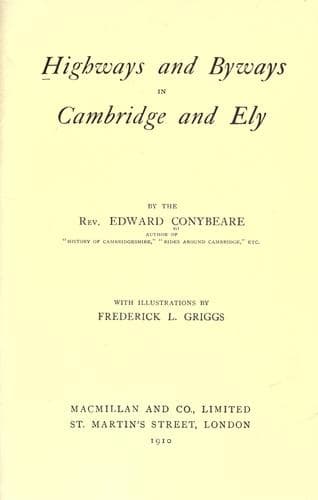
Highways and Byways in Cambridge and ElyConybeare, John William Edward
History
Highways and Byways in Cambridge and Ely
Conybeare, John William Edward
Cambridgeshire (England) -- Description and travel; Isle of Ely (England) -- Description and travel
London Road.--Trumpington, Church, Brass, Chaucer's Mill, Byron's
Pool, Upper River.--Grantchester, Church.--Cam and Granta.--The
Shelfords.--Sawston, Old-world Industries, Hall, Hiding-Hole,
"Little John."--Whittlesford, Old Hospital.--Duxford.--Triplow
Heath, Civil War.--Fowlmere, Hinxton, Sacring Bell.--Ickleton,
Monolith Pillars.--Chesterford.--Icknield Way.--Saffron Walden.
Due south from Cambridge goes the great London Road, a name now
practically supplanted by the local designation of Trumpington Road.
Trumpington, two miles out, is already joined to Cambridge by a string
of suburban villas; but these are only on one side of the road, while
the other is a continuous line of nightingale-haunted elms, not even
the stench and dust of the motorist having availed to drive away those
fearless songsters. In leaving the Town the road starts along Hobson's
Conduit, passing the Botanic Gardens, and crosses Vicar's Brook at the
historic milestone already described on page 160, the first to be set
up in England since the days of the Romans.
Trumpington Church shares with Salisbury Cathedral the distinction of
being built wholly in the Early English style at its best; and it has
what is, perhaps, the best-known brass in England, that of Sir Roger
de Trumpington, one of the crusading comrades of Edward the First. The
knight is in full panoply of chain-armour, with steel epaulettes (or
ailettes as they were then called) protecting his shoulders. His
helmet is secured by a chain to his girdle, an unusual precaution, and
his large concave shield is charged with his punning arms, two golden
trumpets.
From the Church an alluring hollow lane winds down to a flat green
island meadow (once a swamp, and still often flooded) between two
branches of the Cam, dividing Trumpington from the sister village of
Grantchester. On the Grantchester side of this island we come to a
mill, with a specially delicious mill-pool below it, overhung by a
wreath of foliage, chiefly chestnut. This is the representative of the
mill immortalised by Chaucer, in the Canterbury Tale which describes
so picturesquely the somewhat unsavoury adventures of the Cambridge
"clerks":
At Trompyngtoun, nat far fro Cantebrigge,
There goth a brook, and over that a brigge,
Upon the whiche brook ther stant a melle,
And this is verray sothe that I you telle.
Public-domain text, read in full here on John Shaqi.
Reviews
Reviews
No reviews yet
Be the first to share your thoughts on this work.
Elsewhere in the archive
Join the Discussion
Join the discussion
Sign in to leave a comment or review.
Sign InorCreate an account