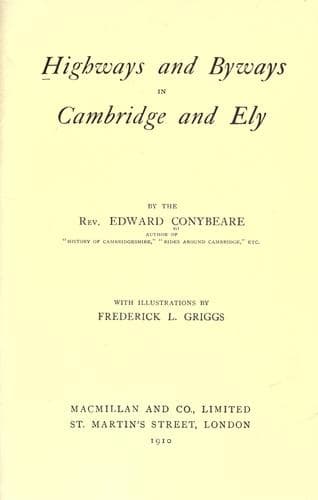
Highways and Byways in Cambridge and ElyConybeare, John William Edward
History
Highways and Byways in Cambridge and Ely
Conybeare, John William Edward
Cambridgeshire (England) -- Description and travel; Isle of Ely (England) -- Description and travel
The present mill, however, is not on the actual site of Chaucer's,
which stood some quarter of a mile higher up the stream. Its mill-pool
still exists, and is famed as "Byron's Pool." Hither the poet used
constantly to make his way when an undergraduate, as a retired spot
where he might enjoy his favourite delight of bathing, which even in
his day was a practice somewhat frowned upon by the academic
authorities. A century or so earlier, as has been already said, any
student found guilty of it was publicly flogged in the Hall of his
College.[164] It is a fascinating place, overhung by fine trees, and
remained in favour as a bathing-place even to the middle of the
nineteenth century. Now it has become so silted up as to be
practically useless. But on the river above it there is still a good
swimming reach, little used, however, as most students are content
with the University bathing sheds between Grantchester and Cambridge.
[Footnote 164: See p. 153. After this preliminary domestic castigation
he was again flogged on the morrow in the University Schools by the
Proctors. A second offence meant expulsion from the University!]
The footpath past these sheds is a pleasant byway between the two
places, through the green meadows along the riverbank, and so also is
the river itself, hereabouts no more than the "brook" which Chaucer
calls it. It is, however, by no means a water to be played with
rashly, having a tortuous course full of deep holes, in which many
lives have been lost. Indeed, no student is now allowed on this "Upper
River," unless a certified swimmer. A third alternative route is
afforded by the lane between Grantchester and Newnham. Though the
southern half of this suburb is actually in Grantchester parish, the
lane still runs through open fields, and Grantchester itself is in no
sense suburban.
A strangely zig-zag road (with no fewer than four right-angle bends to
left and right alternately in as many hundred yards), climbs from the
mill to the church, which stands, like Trumpington, on the gravel
terrace above the river. These river gravels are amongst the most
interesting of Cambridgeshire geological formations. Not only does
their height above the present stream level (sometimes as much as
thirty feet) point to an age when the rivers must have been much
larger than now, but they are prolific in organic remains, indicating,
sometimes a warmer, sometimes a colder climate than ours. Here, at
Grantchester, bones of the mammoth and of the woolly rhinoceros
connote subarctic conditions; but a few miles further up the Cam, at
Barrington, the terrace is full of hippopotamus, along with elephant
and rhinoceros of African type, postulating a sub-tropical
temperature.
Public-domain text, read in full here on John Shaqi.
Reviews
Reviews
No reviews yet
Be the first to share your thoughts on this work.
Elsewhere in the archive
Join the Discussion
Join the discussion
Sign in to leave a comment or review.
Sign InorCreate an account