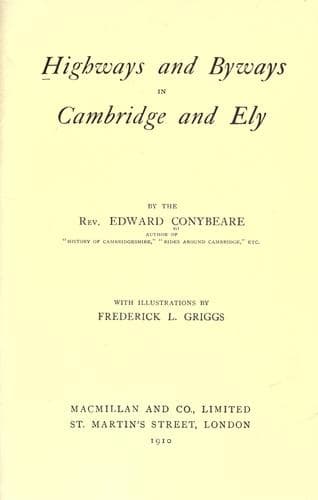
Highways and Byways in Cambridge and ElyConybeare, John William Edward
History
Highways and Byways in Cambridge and Ely
Conybeare, John William Edward
Cambridgeshire (England) -- Description and travel; Isle of Ely (England) -- Description and travel
The knee-holm, or butchers' broom, used in the Sawston leather work,
grows at Whittlesford, on the other side of the Granta, a pretty,
shady village with an interesting church; the development of which,
from a Saxon nucleus, is a nice (and not yet satisfactorily solved)
problem for lovers of mediaeval architecture. There is a wooden porch
(oak) of the fourteenth century. At Whittlesford Bridge, where the
Granta is crossed by the Icknield Street, close to the railway
station, one sees, hard by the road, a decayed stone edifice, with a
high pitched roof thatched with reeds, now used as a barn.
[Illustration: _Whittlesford._]
This is the chapel of the ancient Hospital of St. John, founded in the
thirteenth century. There were several such institutions in
Cambridgeshire, started, not specially for the care of the sick, but
for "hospitality" in the widest sense of the word. Here travellers
were entertained, the hungry were fed, the needy were ministered to,
according to their several necessities. The Hospitals were rarely
large institutions, and this one, as the size of its chapel shows, was
quite a small affair, only endowed with some sixty acres of meadow
land and a water-mill, equivalent, probably, to some L200 a year in
all. But having been under the direction of a prior (appointed by the
Bishop of Ely), it is sometimes known by the high-sounding title of
Whittlesford Priory. The interior of the building still retains some
beautiful early English work. A specially pleasant roadside hostelry
next door (the Red Lion), with deliciously quaint carvings on mantel
and ceiling, may be held, in some sense, its modern representative;
and, indeed, is thought by many authorities to have actually formed
part of it.
Though, for some reason, always associated with the name of
Whittlesford, this Hospital is actually in the adjoining parish of
Duxford, or rather in one of the two (now consolidated) parishes of
St. John and St. Peter, between which this little village is divided.
Both churches still exist (though St. John's is now only used for
burials in its churchyard), and both are very much of the same build,
mainly Early English, with a little Norman, of which St. John's
steeple is the most noteworthy example. St. Peter's has a beautiful
"low-side" window in the northern wall of the chancel.
To the west of Duxford the Icknield Street traverses a wide bleak
expanse of treeless fields which, until the nineteenth century, were
the unenclosed turf-land forming the famous Triplow Heath, the scene
of the first breach between the Long Parliament and its army. In the
view of the Parliament that force had now done its work. The Cavalier
levies had been stamped out, the king had been "bought" from the
Scots, and was in Parliamentary custody at Holmby House in
Northamptonshire, the Scots themselves had withdrawn to their own
country; why then should not this costly, and rather dangerous, army
be disbanded?
Public-domain text, read in full here on John Shaqi.
Reviews
Reviews
No reviews yet
Be the first to share your thoughts on this work.
Elsewhere in the archive
Join the Discussion
Join the discussion
Sign in to leave a comment or review.
Sign InorCreate an account