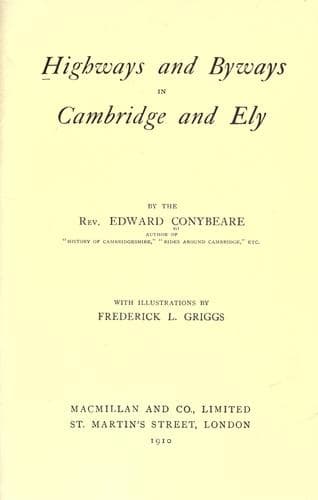
Highways and Byways in Cambridge and ElyConybeare, John William Edward
History
Highways and Byways in Cambridge and Ely
Conybeare, John William Edward
Cambridgeshire (England) -- Description and travel; Isle of Ely (England) -- Description and travel
But this was far from being the view of the soldiers themselves. A
return to the monotonous routine of civil life, after the thrilling
excitements of civil war, had no attractions for them; least of all, a
return without their pay. That pay--one shilling a day--was more than
double the current wages; and now it was many months behindhand--a
whole year in some cases. The suggestions of disbandment were met,
accordingly, by the concentration of the troops, including Cromwell's
famous regiments, on Triplow Heath, in his own East Anglian district.
This was on the 10th of June, 1647.
[Illustration: _St. Peter's Church, Duxford._]
Commissioners from the Parliament were sent down from Westminster,
with offers of two months' pay in cash and debentures for the
remaining arrears, contingent on disbandment. But this was not nearly
good enough; and the offers were met with cries of "Justice! Justice!"
from the men, and with significant hints from the officers of a march
on London if their claims were not speedily satisfied, "for a rich
city may seem an enticing bait to poor beggarly soldiers to venture
far to gain the wealth thereof."
And, while the baffled Commissioners returned, to call out the London
train-bands to meet the threatened attack (finding them so reluctant
to face this new and terrific foe that the death-penalty had to be
denounced against all malingerers), the Army took more effective
action by despatching Cornet Joyce, with a troop of horse, to seize
the King at Holmby House and bring him along as a prisoner; or, as
they put it, to rescue him from his Parliamentary jailers, and invite
him to trust his person with his faithful soldiers. They might thus be
able to sell him again to the Parliament, as the Scots had done, or
they might really restore him, for a sufficient consideration, or make
their own of him some way. And, while Charles was being thus carried
off, as we have already seen, to Chippenham, they struck their camp
and marched off along the Icknield Street to Royston, and thence to
St. Albans, as a demonstration against London. When the unhappy
monarch, a fortnight later, on Midsummer Day, was brought by the same
route from Newmarket, crossing Whittlesford Bridge and passing through
the midst of Triplow Heath, the scene had already returned to its
habitual loneliness.
Triplow itself lies to the west of the Heath, and has a far-seen
cruciform Church, sister to that in the adjoining village of Foulmire,
or Fowlmere as it ought to be spelt. An actual mere, noted for its
wealth of wild fowl, existed here till little more than half a century
ago. It is now a worthless patch of land, full of springs and runlets.
There is also a small prehistoric earthwork, known as "The Round
Moats."
Public-domain text, read in full here on John Shaqi.
Reviews
Reviews
No reviews yet
Be the first to share your thoughts on this work.
Elsewhere in the archive
Join the Discussion
Join the discussion
Sign in to leave a comment or review.
Sign InorCreate an account