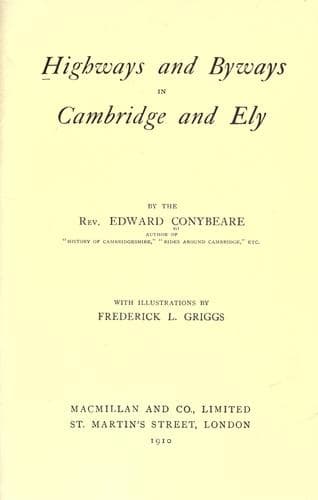
Highways and Byways in Cambridge and ElyConybeare, John William Edward
History
Highways and Byways in Cambridge and Ely
Conybeare, John William Edward
Cambridgeshire (England) -- Description and travel; Isle of Ely (England) -- Description and travel
From Duxford, a pretty byway--far prettier till, a year or two ago,
the picturesque wooden foot-bridge across the Granta was replaced by
an iron modernity--leads to Hinxton, where the church has some
interesting architectural developments, and a good brass to Sir Thomas
de Skelton, steward to "old John of Gaunt, time-honoured Lancaster."
He is shown in full plate-armour, and his two wives lie beside him.
The Parochial Register here dates back to the very first institution
of such documents, in 1538, by Thomas Cromwell. This is quite rare;
for the idea was, in its first inception, to the last degree unpopular
both with clergy and people, who suspected, from their experience of
Henry's illimitable greed, that a tax would be exacted upon each of
the ecclesiastical functions thus registered.
On the outside of the spire, which is of wood covered with lead, hangs
a "Sanctus" (or "Sacring") Bell, which of old was rung at those places
in the High Mass where a small bell is sounded by the Server at the
Altar; that is to say, at the _Ter Sanctus_ and the Consecration of
the Host. Thus those of the faithful who were unable to attend church
were invited to unite themselves in spirit with the worshippers there
at the most solemn moments of the Service. Few of these bells remain,
as their associations were, of course, specially distasteful to
Protestant feeling, so that they were mostly destroyed at the
Reformation.
At Hinxton we are on the borders of Essex, and a shady
westward-running lane takes us on, across the river and the railway,
to the last Cambridgeshire village on this line, Ickleton, where the
church is of quite unique interest. Here, too, there is a Sacring
Bell, on the side of the steeple; surviving, doubtless, through the
same unknown local influence which also saved that on the sister spire
of Hinxton. But the real interest of the church is entirely hidden
from passers by. Those even who look from the pretty little Village
Green to the southward see nothing that calls for notice, except the
Sacring Bell and a fairly good Geometrical window in the steeple. The
rest of the exterior shows only poor fourteenth century work--and
cruelly "restored" at that.
But, once inside, we discover that the unsightly exterior is but an
outer shell, built round, and over, a smaller and far older church,
still standing, and so entirely enclosed that its clerestory lights
now open into the existing aisles. Above them are the lights of the
later fourteenth century clerestory, which, no doubt, originally
contained Geometrical, or more probably Flowing, tracery. Now,
however, they are mere "churchwarden" apertures, of various indefinite
shapes, with mean wooden sashes, having been remorselessly doctored in
the second decade of the nineteenth century.
Public-domain text, read in full here on John Shaqi.
Reviews
Reviews
No reviews yet
Be the first to share your thoughts on this work.
Elsewhere in the archive
Join the Discussion
Join the discussion
Sign in to leave a comment or review.
Sign InorCreate an account