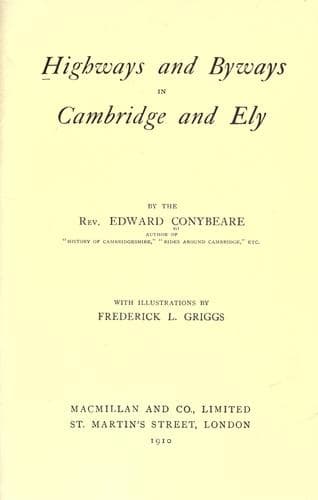
Highways and Byways in Cambridge and ElyConybeare, John William Edward
History
Highways and Byways in Cambridge and Ely
Conybeare, John William Edward
Cambridgeshire (England) -- Description and travel; Isle of Ely (England) -- Description and travel
The land of Ickleton was almost wholly _Terra Ecclesiae_. A priory of
Benedictine nuns existed here, founded in the twelfth century by
Aubrey de Vere, the first Earl of Oxford; while the Abbeys of East
Dereham in Norfolk, Tyltey in Essex, and even Calder (a "cell" of
Furness), in far-off Cumberland, each possessed a Manor in the
Parish. All alike were given by Henry the Eighth to Goodrich, Bishop
of Ely, in exchange for the far more valuable property of Hatfield
House. Queen Elizabeth, however, afterwards demanded them all back
again, with much other land, as a condition of appointing Bishop
Heton, in 1600, to the See, which she had kept vacant to fill her
coffers for no less than nineteen years. The Manors were sold by the
Crown, and are now in private hands. The benefice is in the gift of
the Lord Chancellor.
The name Ickleton, like those of Ickborough in Norfolk, Ickingham in
Suffolk, and Ickleford in Hertfordshire, is derived from the position
of the village on the line of the Icknield Way. It may indeed be the
direct linguistic descendant of the Roman _Icianos_. We must bear in
mind that a prehistoric track, such as the Icknield Way, was not one
single-metalled thoroughfare like a Roman road or a modern highway,
but a broad line of route along which each traveller made his own
"trek," so that the "Way" was a series of roughly parallel ruttings
over the breadth of a mile and more. Such, to this day, are the routes
across the Siberian steppes, which are often four or five miles
across. Thus we found the Icknield Way at Whittlesford, three miles
north of Chesterford, and it is probable that all the various "fords"
we have been meeting--Shelford, Stapleford, Whittlesford,
Duxford--have to do with its various passages of the Granta.
Beyond Chesterford the Granta comes down in tiny streamlets from the
Essex chalk near Saffron Walden, with its wide-naved church, which
Cromwell's troops used for a drill-shed and council-chamber, and its
historic mansion of Audley End, once Walden Abbey, and its memories of
the days, scarcely a century by-gone, when great crops of saffron were
grown in its fields, leaving their only existing trace in the name.
And even that is dying out; few of the inhabitants call their home
anything but Walden. But this town is beyond our Cambridgeshire
border.
CHAPTER XI
Public-domain text, read in full here on John Shaqi.
Reviews
Reviews
No reviews yet
Be the first to share your thoughts on this work.
Elsewhere in the archive
Join the Discussion
Join the discussion
Sign in to leave a comment or review.
Sign InorCreate an account