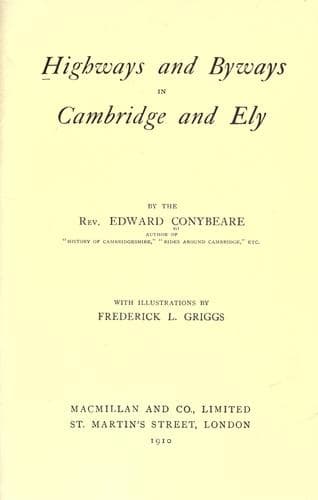
Highways and Byways in Cambridge and ElyConybeare, John William Edward
History
Highways and Byways in Cambridge and Ely
Conybeare, John William Edward
Cambridgeshire (England) -- Description and travel; Isle of Ely (England) -- Description and travel
Haslingfield (which is more directly reached from Cambridge by the
Barton Road) has a fine and spacious church of the fourteenth century,
the steeple being of special merit. Above it rises steeply the eastern
extremity of a chalk spur to the height of 220 feet. From the summit,
though so low, we get one of the widest panoramic views in England,
embracing the whole valley of the Cam. "Ashwell Bush,"[170] which
marks the source of the river, is conspicuous on a hill some ten miles
to the south-westward, and Ely Cathedral, just beyond its junction
with the Ouse, may be seen, twice as far away to the north; Cambridge,
with its spires and pinnacles, lying between, five or six miles
distant. Our eastward limit of vision is the long line of the East
Anglian Heights, from Swaffham steeple[171] on their northernmost
visible swell, twenty miles away, to the far-off jut of Sharpinhoe,
near Dunstable, more than thirty miles in the opposite direction.
Beneath us, in the valley, steeple after steeple rises amid its
village elms, dotting the landscape like knots in net-work. No fewer
than eighty of these can be made out, the most conspicuous being the
cruciform church of Triplow.[172]
[Footnote 170: This "bush" is actually a group of young elms.]
[Footnote 171: See p. 191.]
[Footnote 172: See p. 230.]
[Illustration: _Haslingfield Church._]
This eminence was anciently known as White Hill, from the three great
"clunch" quarries,[173] which still conspicuously scar its sides,
and must have done so much more conspicuously of old, when this
material was much more generally used for building than it is now.
From these quarries came, for example, the stone used in the First
Court of St. John's College, Cambridge. The "pits," as they are
locally called, are rapidly greening over, for the clunch is now only
dug for the mending of farm roads, and occasionally for marling the
fields; as Pliny records that the ancient Britons marled them two
thousand years ago.
[Footnote 173: See p. 198.]
Public-domain text, read in full here on John Shaqi.
Reviews
Reviews
No reviews yet
Be the first to share your thoughts on this work.
Elsewhere in the archive
Join the Discussion
Join the discussion
Sign in to leave a comment or review.
Sign InorCreate an account