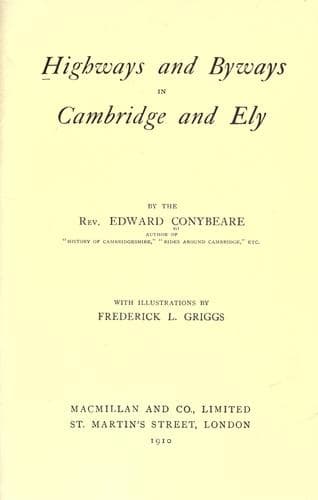
Highways and Byways in Cambridge and ElyConybeare, John William Edward
History
Highways and Byways in Cambridge and Ely
Conybeare, John William Edward
Cambridgeshire (England) -- Description and travel; Isle of Ely (England) -- Description and travel
At the summit of the ridge a small roadside cottage, known as "Chapel
Bush," represents the once famous shrine of "Our Lady of White Hill";
in mediaeval days a noted centre of local devotion, which drew pilgrims
in large numbers from a wide area, so that their accommodation, as we
read, was no small profit (and, often, difficulty) to the neighbouring
villages. No ruins, even, of this ancient chapel remain; but, in 1885,
there was discovered on its site a leaden _bulla_ of Pope Martin the
Fifth, the first Pope to be generally acknowledged after the Great
Schism; when for forty years two (or three) claimants to the Holy See
were reigning simultaneously, supported some by one part of
Christendom, some by another. He reigned 1417 to 1431, and was the
consecrator of Milan Cathedral. It was he who, at the "Assize of
Barnwell" (1430), pronounced that all spiritual jurisdiction over the
students of Cambridge was exclusively vested in the University
authorities. His _bulla_ bears the heads of SS. Peter and Paul, with
the traditional features, which Lanciani has now established as
historical; St. Peter having a broad face with curly hair and beard,
while St. Paul is thin-faced and straight-haired.
On the southern side of the hill lies Barrington, perhaps the
loveliest of all Cambridgeshire villages. It consists of two long
lines of scattered cottages, straggling along either side of a Village
Green nearly a mile in length. The Green is traversed from end to end
by the "Church Path," a pebbled causeway of immemorial antiquity. The
church, to which this leads, stands at the north-eastern extremity of
the Green, and is a noble structure of the twelfth century, with later
developments. The south doorway and door are thirteenth century, and
are wonders of graceful work; while the fourteenth century seats are
of special interest as having been constructed with book-boards,
showing that reading was not the rare accomplishment in those days
that it is commonly supposed to have been.[174] There is also an
iron-bound chest dating from the tenth century, a splendid specimen of
the smiths-work for which England was then so famous. The font, too,
is equally old, showing on its margin the depressions (now filled in),
often provided in fonts of the period when baptism by immersion was
the rule, as outlets for accidental overflow.
[Footnote 174: The Chantry Priests, of whom there were two in
Barrington, often acted as village schoolmasters, the Chantries
themselves serving as classrooms.]
[Illustration: _Farmhouse at Haslingfield._]
Public-domain text, read in full here on John Shaqi.
Reviews
Reviews
No reviews yet
Be the first to share your thoughts on this work.
Elsewhere in the archive
Join the Discussion
Join the discussion
Sign in to leave a comment or review.
Sign InorCreate an account