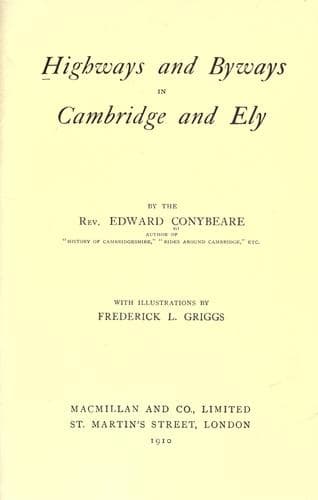
Highways and Byways in Cambridge and ElyConybeare, John William Edward
History
Highways and Byways in Cambridge and Ely
Conybeare, John William Edward
Cambridgeshire (England) -- Description and travel; Isle of Ely (England) -- Description and travel
Here and there along the Green gush out bright fountains of delicious
water from artesian wells driven into the "greensand," some 200 feet
below the surface. Throughout all its length the village is sheltered,
on the north, by the ridge of White Hill, while, on the south, the
orchards and closes with their "hedge-row elms," slope down to the Cam
and its water-meadows. The stream here runs beneath a gravel-terrace
of its own formation, which has proved exceptionally rich in the
remains of pleistocene mammalia, mostly, as has been said,[175]
connoting a semi-tropical climate. Specimens of elephant,
hippopotamus, rhinoceros, bison, urus, lion, bear, hyaena, derived from
Barrington, are to be seen in the Sedgwick Museum at Cambridge.
Associated palaeolithic flint implements, and red-deer antlers rudely
cut, show that human intelligence existed here along with these
monsters, at least 5000 years ago, at the lowest estimate, which some
geologists multiply fifty fold; and excavation has shown that the site
has been populated pretty well ever since. Neolithic, British, Roman,
Anglo-Saxon, and Mediaeval relics have here been unearthed in quite
astonishing abundance; and, though no Roman villa has yet been
located, Roman coins have been found literally by the hundred.
[Footnote 175: See p. 221. The gravel here is older than that at
Grantchester.]
This wealth of finds has been largely due to the "coprolite" digging,
as it was inaccurately called, which went on here (and throughout the
neighbourhood) during the whole latter half of the nineteenth century.
It had been discovered that the "upper greensand"[176] (here a narrow
deposit immediately over the gault and usually some fifteen or twenty
feet below the surface) was full of organic remains worth extracting
for manure. These remains were never true coprolites, but mostly
formless nodules rich in phosphate of lime, many being sponges, along
with abundance of sea-urchins, mollusca, crabs, and innumerable
sharks' teeth.
[Footnote 176: So called because full of green grains of "glauconite,"
which appear to be the internal casts of the shells of foraminifera.
This bed, however, is not the true Upper Greensand, but "riddlings"
from it.]
The industry brought a wave of prosperity to the district; for
coprolites were worth some L3 per ton, and the average yield was some
300 tons per acre. The merchants were, therefore, willing to pay well
for the privilege of digging them out, and usually offered the
landowner L150 or more per acre for three years' occupation of the
land (more than its capital value); being bound also to level and
resoil it at the end of their tenancy. Wages, too, ran high; a good
"fossil-digger" could earn his 40_s_. per week. This produced a
corresponding rise in agricultural wages, which went up from 10_s_. or
12_s_. per week to double that amount. The fossil-digging was all
piecework, the men being paid by the cubic yard of earth moved.
Public-domain text, read in full here on John Shaqi.
Reviews
Reviews
No reviews yet
Be the first to share your thoughts on this work.
Elsewhere in the archive
Join the Discussion
Join the discussion
Sign in to leave a comment or review.
Sign InorCreate an account