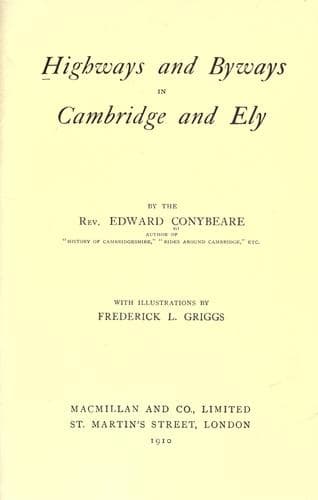
Highways and Byways in Cambridge and ElyConybeare, John William Edward
History
Highways and Byways in Cambridge and Ely
Conybeare, John William Edward
Cambridgeshire (England) -- Description and travel; Isle of Ely (England) -- Description and travel
Another, and perhaps prettier, way of reaching Ashwell from Cambridge
is by taking the road that runs along the Backs, and following it out
of the town in its course to the south-west. Its local designation is
the Barton Road, but to antiquarians it has been known, since the
seventeenth century, as the Akeman Street. It was at that period that
the accepted identification of our Roman roads came into being, mainly
through the fearless erudition of Gale. Their names (except that of
the Via Devana) are as old at least as the Norman Conquest; but, save
only in the case of the Watling Street, the main line of which has
never been disputed, the connection between any given name and any
given road has been matter for the wildest conjecture. Thus, Geoffrey
of Monmouth, writing in the eleventh century, makes the Ermine Street
(which we now, with strong reason, identify with the Old North Road
from London to York) run from St. David's to Southampton! Our Akeman
Street is supposed to connect Wells on the Wash with Aust on the
Severn, passing on its way through Bath (the Ake-man-chester of the
Anglo-Saxons, _i.e._, "the stone stronghold of Aquae," Aquae being the
Roman name for Bath). But a lot of this is mere conjecture. The
"Barton Road," however, is undoubtedly on the line of a Roman road.
In spite of its name, it does not pass through the village of Barton.
Indeed, like the other roads leading westwards from Cambridge, it
curiously avoids the villages on its line, or rather (for the road is
older than they) the villages have curiously avoided being directly
upon it, though they lie thick on either side. Possibly the first
Anglo-Saxon settlers may have had in this district some superstitious
dread of a deserted Roman road, such as they certainly entertained at
first for the deserted Roman towns, which they did not occupy for many
a year (as at Cambridge), though they located their hamlets all round
them.
[Illustration: _Ashwell Church._]
But though the Akeman Street does not actually take us through
Barton village, it does lead us past the rare object of interest to be
found connected with the place, the ancient Archery Butts of the
parish. These are to be seen just opposite the sign-post which points
to Haslingfield, and are worth a pause to contemplate, for they give a
most impressive idea of what archery meant to our forefathers. Every
parish, it must be remembered, was bound by law in mediaeval times to
have such a stretch of ground, and every yeoman was bound to constant
practice upon it. And what practice! These "butts" are a stretch of
greensward, some hundred yards across, and in length no less than
three furlongs (660 yards). It looks an almost incredible distance for
a bowman, but it was the standard, so far as we can judge by the very
few butts of which the memory still survives. The length of the short
street in South London, still called Newington Butts, is nearly the
same.
Public-domain text, read in full here on John Shaqi.
Reviews
Reviews
No reviews yet
Be the first to share your thoughts on this work.
Elsewhere in the archive
Join the Discussion
Join the discussion
Sign in to leave a comment or review.
Sign InorCreate an account