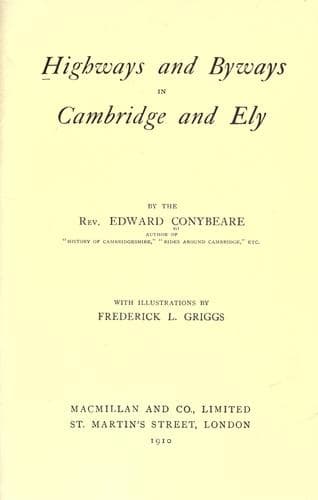
Highways and Byways in Cambridge and ElyConybeare, John William Edward
History
Highways and Byways in Cambridge and Ely
Conybeare, John William Edward
Cambridgeshire (England) -- Description and travel; Isle of Ely (England) -- Description and travel
Here, then, we can picture the sturdy archers of Plantagenet days
stretching themselves; their bows, not the toys of the modern
toxophilite with their thirty or forty pounds of pull, but of twice
the power (eighty lb. being a common pull in those times), and their
"cloth-yard" arrows, over three feet long, whistling to a target not
planted forty or fifty yards away, but twelve times the distance--the
whole length of these butts. Indeed, for anything under two furlongs
light arrows were not allowed, and the heavy regulation war arrow had
to be used. Each man was taught, as Bishop Latimer tells us in
recording his own youthful training, to draw his bow not by mere
strength, but by sleight of hand, "to lay the weight of his body into
the bow," and to draw the bowstring not to his breast, like other
nations, but to his ear. Small wonder that with eye and sinews so
trained our English archers became the wonder and the dread of Europe,
or that their shafts decided so many a battlefield--Cressy, Poictiers,
Agincourt, Flodden.
A mile further we cross the Bourn Brook, a tiny tributary which joins
the Cam near Grantchester, hard by a small station on the Cambridge
branch of the London and North Western Railway, called Lord's Bridge,
from the Lord Hardwicke who, in the beginning of the nineteenth
century, substituted a bridge for the earlier ford here. To our right
we see, across the fields, the church tower of Comberton; where, on
the little village green, can still be seen the worn remains of a
turf-built "maze," first traced out no one knows when, but certainly
not later than the sixteenth century. Various mystical reasons are
conjectured for the origin of these mazes, of which a fair number
still exist in England (especially in the Eastern counties), while
many more are known to have been destroyed by the Puritans of the
seventeenth century as relics of heathen superstition. Such, indeed,
they probably are. Mr. Walter Johnson, in his "Folk Memory," considers
them to be exceedingly primitive, begun in connection with "ceremonial
dances of painted heathen round a prehistoric camp fire." This
Comberton maze is fifty feet in diameter, while the tracks are two
feet in width, divided by slight banks of turf, once, it would seem,
about a foot in height, but now much worn down.
The next turn (to the left) leads to Harlton, a pretty, shady village,
with a fine Perpendicular church, having a stone rood screen, which is
rare, and, what is yet rarer, a still surviving stone reredos of the
fifteenth century, with a central recess, once closed with a door, and
evidently intended as a "Tabernacle" for the Reservation of the
Blessed Sacrament. The six niches on either side of this recess were
as evidently meant for images of the twelve Apostles.
Public-domain text, read in full here on John Shaqi.
Reviews
Reviews
No reviews yet
Be the first to share your thoughts on this work.
Elsewhere in the archive
Join the Discussion
Join the discussion
Sign in to leave a comment or review.
Sign InorCreate an account