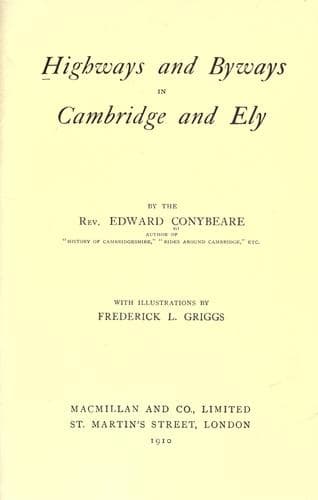
Highways and Byways in Cambridge and ElyConybeare, John William Edward
History
Highways and Byways in Cambridge and Ely
Conybeare, John William Edward
Cambridgeshire (England) -- Description and travel; Isle of Ely (England) -- Description and travel
In the south aisle is preserved a small crucifix of stone, dating from
the thirteenth century. It had been built into the wall to save it
from destruction at the Reformation, and was not discovered for three
hundred years.
About a mile further we find a village along the road itself, the
village of Wimpole. But we notice that the houses are all modern, and
that no church is to be seen amongst them. A church there is belonging
to them, but it stands a mile to the west, where the village also
stood till towards the close of the eighteenth century. At that time
the mansion and park of Wimpole Hall were being enlarged to their
present magnificence by Philip, the first Earl of Hardwicke (the
builder of Lord's Bridge). Plebeian cottages were not to be tolerated
"betwixt the wind and his nobility," so he pulled down the entire
village and planted it, where it now is, along the Akeman Street. The
church, which could not well be moved, he faced with red brick to
match his new-built stables, close to which it is situated.
[Illustration: _Great Eversden._]
Wimpole Hall has passed through various hands. The central portion was
built, in 1632, by Sir Thomas Chicheley, the wings were added a
century later by the Earl of Oxford, from whom it came to the
Hardwicke family. It is now the seat of Viscount Clifden. The house is
on a splendid scale, and the grounds on a scale yet more splendid,
with a double avenue of elms, three miles long, running to the south.
Here Queen Victoria stayed when visiting Cambridgeshire shortly after
her marriage, and won all hearts by her graciousness. It is still
remembered how when, by some blunder, the attendant in charge of her
jewels was not forthcoming, she came down to the ball-room with a
simple wreath of roses in her hair, "and not all the jewels in the
world could have made her look so queenly."
There is, of course, a public road leading from Wimpole village to the
church, which is also accessible from the west, where the great iron
gates of the park are usually unbarred at the request of respectable
visitors. These gates open upon the Ermine Street, which the Akeman
Street crosses a mile beyond New Wimpole, after also crossing the
great avenue. Close by them is another transplanted village,
Arrington, whose church stands on the hill half a mile westward. The
traffic of the old North Road is responsible for this move, and also
for the delightful old coaching inn here, the Hardwicke Arms, with its
old-fashioned rooms and long range of stables.
Public-domain text, read in full here on John Shaqi.
Reviews
Reviews
No reviews yet
Be the first to share your thoughts on this work.
Elsewhere in the archive
Join the Discussion
Join the discussion
Sign in to leave a comment or review.
Sign InorCreate an account