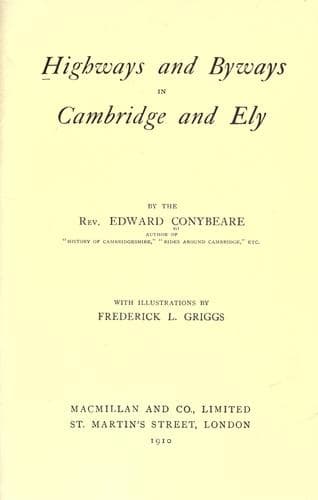
Highways and Byways in Cambridge and ElyConybeare, John William Edward
History
Highways and Byways in Cambridge and Ely
Conybeare, John William Edward
Cambridgeshire (England) -- Description and travel; Isle of Ely (England) -- Description and travel
At the junction our road ceases. To continue our westward course we
must go along the Ermine Street for half a mile, either northward or
southward, where we shall find lanes, either of which will carry us
on. The northern lane here will take us along the line of the hill, to
Tadlow, Wrestlingworth, Potton, and, finally, Bedford, and will enable
us, if we will, to explore the three Hadleys (East Hadley, Hadley St.
George, and Cockayne Hadley), of which the two last have fine halls
and parks. The southern, however, is the preferable route. It follows
the course of the infant Cam, crossed by a bridge on the Ermine
Street, and brings us first to the wholly obliterated Shingay, which,
though once the most important parish hereabouts, and still giving its
name to the Rural Deanery, has absolutely ceased to exist, church and
all; its parishioners being affiliated to the neighbouring village of
Wendy.
The cause of this ruin was the suppression, at the Reformation, of the
institution which was literally the life of Shingay, a House of the
Crusading Order of St. John of Jerusalem, or, as they were commonly
called, the Knights Hospitallers. This title was given them because,
at their original foundation, they dwelt in a Hospital (or house for
the hospitable entertainment of pilgrims) at Jerusalem. We now connect
this name only with places where the sick are ministered to; but it
originally connoted far wider ministrations, and, indeed, rather
corresponded to the other form in which the word has survived into our
present speech--hotel. We read it on a leaden seal found here at
Wendy, in 1876, which bears on one side a conventional representation
of the Shrine of the Holy Sepulchre, surrounded by the legend
IHERVSALEM, HOSPITALIS. On the other is the name of Guarin de
Montaigu, who, from 1232 to 1269, was Grand Master of the Order.
The Hospitallers, as readers of "Ivanhoe" know, were, like the
Templars, a military Order, who, for over six centuries, fought
unceasingly for Christendom. First at Jerusalem, then at Rhodes, then
at Malta, they held out with never-failing devotion against the
on-sweeping torrent of Mahommedan aggression; and it is scarcely too
much to say that but for their eight-pointed cross Christianity might
well have been crushed throughout Europe. Not till the nineteenth
century was their last stronghold, Malta, reft from them by Napoleon,
to pass finally under the flag of England. The Order still survives,
but the modern sodality calling itself by the same name, connected
with what we now call hospital work, was set up in quite recent days.
Public-domain text, read in full here on John Shaqi.
Reviews
Reviews
No reviews yet
Be the first to share your thoughts on this work.
Elsewhere in the archive
Join the Discussion
Join the discussion
Sign in to leave a comment or review.
Sign InorCreate an account