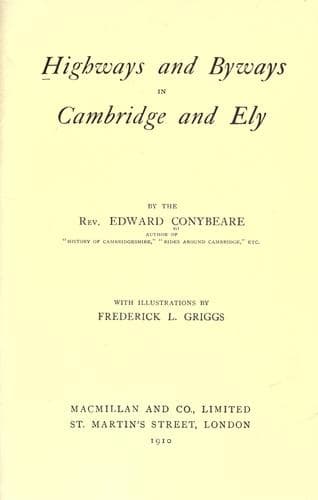
Highways and Byways in Cambridge and ElyConybeare, John William Edward
History
Highways and Byways in Cambridge and Ely
Conybeare, John William Edward
Cambridgeshire (England) -- Description and travel; Isle of Ely (England) -- Description and travel
For more than a decade the irregularities in the motion of Uranus
(itself not long discovered) had suggested to astronomers that there
must be another planet exterior to it, when, in 1841, John Couch
Adams, then only an undergraduate of St. John's College, set himself
to grapple with the arduous task of finding by analytical computation
the orbit and place of this supposititious body. So stupendous were
the difficulties that when, after four years of concentrated effort,
he submitted his results to the Astronomer Royal, begging that the
planet might be looked for in a certain spot (where we now know that
it actually was visible at the time), his suggestion received very
incredulous acceptance. Was it likely that a mere youth should have
solved this gigantic problem?
That very autumn of 1845 another young man, quite independently,
devoted himself to the same quest, the brilliant French mathematician
Leverrier. He, in the following summer, published the results he had
so far attained. Adams had never published; but these new results so
strikingly agreed with his that the Astronomer Royal's incredulity
gave way, and he desired that search should be made with the great
equatorial telescope, then newly erected at Cambridge through the
generosity of the Duke of Northumberland.
His injunctions were carried out; but the lack of a trustworthy star
map made the work long. And it was made longer by lack of promptitude.
The minute celestial object (only equal to a star of the eighth
magnitude) had been actually seen, but further observations were
needed to establish the fact that it was indeed a planet moving
amongst the stars around it. And these observations were delayed at
the crucial point by the observers adjourning for a cup of tea! When
they returned the sky had clouded over and no favourable night
occurred for many evenings after. Meanwhile Leverrier had called in
the aid of the Berlin Observatory; where there did exist a good star
map, and also the eagerness so sadly lacking here at Cambridge. The
very day his letter was received (23rd September, 1846), the great
Berlin telescope was directed to the spot which he indicated,--and
there was the planet.
The story goes that when the tidings of this overthrow of hope
reached Cambridge, and were reported to the Fellows of Trinity as they
sat at dinner in their Hall, it was as if a thunderbolt had fallen
amongst them:
"And all talk died, as in a grove all song
Beneath the shadow of some bird of prey;
Then a long silence came upon the Hall,"
Public-domain text, read in full here on John Shaqi.
Reviews
Reviews
No reviews yet
Be the first to share your thoughts on this work.
Elsewhere in the archive
Join the Discussion
Join the discussion
Sign in to leave a comment or review.
Sign InorCreate an account