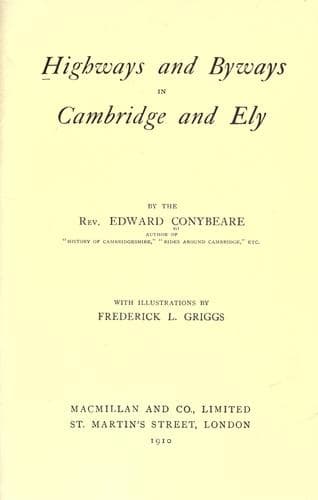
Highways and Byways in Cambridge and ElyConybeare, John William Edward
History
Highways and Byways in Cambridge and Ely
Conybeare, John William Edward
Cambridgeshire (England) -- Description and travel; Isle of Ely (England) -- Description and travel
broken at last by Adam Sedgwick, the venerable Professor of Geology,
who solemnly raised his clenched fist and brought it down upon the
High Table, not with violence but with a concentrated tension of
indignation, saying slowly, with an equal solemnity: "Confound their
lymphatic souls."[181] As for the Observatory, the blow thoroughly
roused it up; and ever since it has remained, both in material and
moral equipment, amongst the foremost of the great Observatories of
the world, where solid and useful work is continuously being done,
while up-to-date instruments, methods, and records are never to seek.
On one evening of each week during term time any member of the
University may see the practical working of the place, and bring
friends with him.
[Footnote 181: The discovery of Neptune is by no means the only
discovery the honour of which has been lost to Cambridge through that
scientific temper of mind which is loth to publish investigations at
an early stage of their verification. Months before Marconi introduced
wireless telegraphy to the public it had been practised here by
Professors Rutherford and Sir J. J. Thomson; the first serious
messages being exchanged, over a distance of two miles, between the
Cavendish Laboratory and the Observatory. At the same Laboratory the
Roentgen rays were being investigated ere yet Roentgen became a
household word. And long years before Bunsen and Kirchoff (in 1859)
published the true explanation of Fraunhofer's dark lines in the solar
spectrum, that explanation had been given to his pupils by yet another
Cambridge Professor, Sir George Gabriel Stokes. Such indifference to
mere fame reminds us of the old saying that an Oxford man looks as if
all the world belonged to him, a Cambridge man as if he did not care
whom it belonged to.]
A mile further we reach the foot of the chalk slope which bounds the
Cam valley. At this point lanes diverge to the right and left. The
latter almost immediately brings us to Coton, a tiny village with a
tiny, but most picturesque, fourteenth century church, having a
(restored) Norman chancel, a pretty spire, and a yet prettier south
doorway. There is, too, a massive rood screen, and a curious
"palimpsest" Table of Commandments, the original sixteenth century
lettering showing beneath repainted characters of the seventeenth
century. Altogether the place is well worth the slight divergence
needed to visit it, more especially as the lane between it and our
road gives a view of Cambridge almost comparable to the prospect of
"That sweet City, with her dreaming spires"
which the Cumnor slopes (as Matthew Arnold sings) provide for
Oxonians. Coton can also be reached from Cambridge by a delightful
field path beneath overhanging oaks, which runs straight from Garret
Hostel Bridge. Coton spire (as has been already mentioned) is the
"objective" of the Trinity avenue, though the view has long been
closed out by the growth of the branches.
Public-domain text, read in full here on John Shaqi.
Reviews
Reviews
No reviews yet
Be the first to share your thoughts on this work.
Elsewhere in the archive
Join the Discussion
Join the discussion
Sign in to leave a comment or review.
Sign InorCreate an account