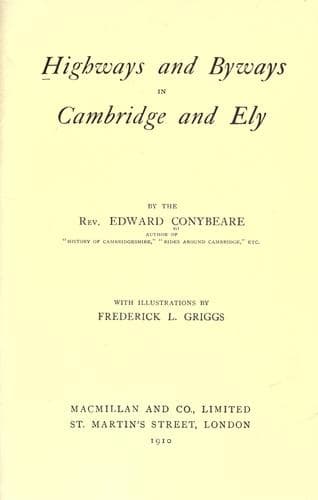
Highways and Byways in Cambridge and ElyConybeare, John William Edward
History
Highways and Byways in Cambridge and Ely
Conybeare, John William Edward
Cambridgeshire (England) -- Description and travel; Isle of Ely (England) -- Description and travel
P.S.--If you have no little Schoole in your town I shall wonder,
and you ought to procure one. If there bee one, then you need not
want a congregation for both morning and evening prayers.
After crossing the Ermine Street we come to Eltisley, where there is a
pretty Village Green and a good village inn; and the church, though
small, has some fine Early English work. It is dedicated to St. John
the Baptist and St. Pandiana (or Pandionia), an obscure personage,
said by Leland to have been a Scottish[186] princess, who found in
this remote spot a refuge from the importunities of her suitors, and
was here buried by the side of a spring still known as St. Pandiana's
Well. Her nunnery perished after the Conquest, and in the fourteenth
century her body was translated into the church, along with that of
the yet more obscure St. Wendreda,[187] a purely Cambridgeshire saint,
whose name is also connected with the church of March, and with a
"well" near Newmarket.
[Footnote 186: _I.e._ Irish. The name of the Scots lingered on in
their original home for many centuries after it became more famous in
North Britain, whither they began to migrate in the fifth century.]
[Footnote 187: See Miss Arnold Forster's Studies in Church
Dedications, chap. xxxi.]
The village is the scene of a dramatic tale found in Roger of
Wendover, under the date 1234. A famine was raging, and the hungry
poor invaded the ripening harvest-fields and devoured the crops, "for
which they may scarce be blamed. Of the farmers, however, (who ever
from their avarice, look upon the poor with an evil eye,) many were
highly wroth at this pious theft. And they of Alboldesley hied them
all on the next Sunday (July 16th) to the church, and with tumult
required the priest to excommunicate upon the spot all who had thus
plucked their wheat-ears. But one pious man alone adjured him in God's
name to pronounce no such sentence for _his_ crops; adding that he was
right well content that the poor should take from him in their need,
and that he commended to the Lord's care whatsoever was left.
"Now scarcely had the priest perforce begun the curse, than there
suddenly arose such a storm of thunder, lightning, whirlwind, rain and
hail, that the corn in the fields was torn from the ground as by a
blast from hell; and all that grew therein, and the cattle, and the
very birds, were destroyed, as though trodden down by carts and
horses. But that just man found his land without trace of harm. And
thus it is clear that as the angels sing Glory to God in the Highest,
so on earth is there Peace toward men of Good-will.
Public-domain text, read in full here on John Shaqi.
Reviews
Reviews
No reviews yet
Be the first to share your thoughts on this work.
Elsewhere in the archive
Join the Discussion
Join the discussion
Sign in to leave a comment or review.
Sign InorCreate an account