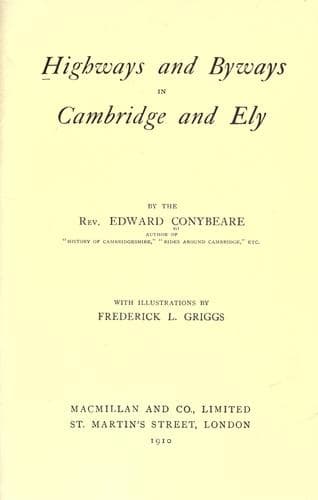
Highways and Byways in Cambridge and ElyConybeare, John William Edward
History
Highways and Byways in Cambridge and Ely
Conybeare, John William Edward
Cambridgeshire (England) -- Description and travel; Isle of Ely (England) -- Description and travel
"This storm began on the borders of Bedfordshire (at Eltisley), and
passed eastwards through the Isle of Ely. And here is a wondrous
thing. Such crops as still stood when it was over were found so
rotted that neither horse nor ass, steer nor pig, goose nor hen, would
eat thereof." A cyclone of precisely the same character devastated
Essex on June 24, 1897, and was as capricious in its visitations.
At Eltisley we reach the termination of the long ridge which has kept
us at an upland level all the way from Madingley, and our road now
runs rapidly down into the valley of the Ouse. We reach that noble
stream at the old-world, but thriving, town of St. Neots, where there
is a fine old bridge and a magnificent church. The name of this place
is locally pronounced not _Neats_, but _Notes_. This last is the
correct form, for the name is derived from Neotus, the eldest brother
and friend of King Alfred, whom that greatest of our monarchs
recognised as the good genius of his life.
The original name of this notable personality was Athelstane. He was
the eldest grandson of Egbert, the first "King of the English," and
held, accordingly, the under-kingship of Kent, at that time the usual
appanage of the heir-apparent. This dignity he resigned to enter
Religion, at the Abbey of Glastonbury, under the name of Neotus. A
special bond of affection united him with his youngest brother,
Alfred, who, as an enthusiastic boy of seventeen, took this dearest of
brothers as his spiritual guide and counsellor. When, five years
later, the successive deaths of the intervening brethren brought him
to the throne, we read that the inconsiderate zeal with which he
suppressed abuses drew anxious warnings from St. Neot, who foresaw
that this overweening course would surely bring disastrous
consequences.
"But Alfred heeded not the reproof of the man of God, nor listed what
he foretold. Wherefore (seeing that a man's sins must needs be some
way punished, either in this world or in that which is to come), the
Righteous Judge and True willed that he should not be unpunished here,
that so he might be spared hereafter."[188]
[Footnote 188: The Chronicle of St. Neots.]
Public-domain text, read in full here on John Shaqi.
Reviews
Reviews
No reviews yet
Be the first to share your thoughts on this work.
Elsewhere in the archive
Join the Discussion
Join the discussion
Sign in to leave a comment or review.
Sign InorCreate an account