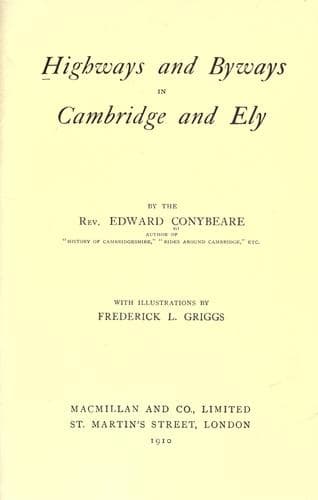
Highways and Byways in Cambridge and ElyConybeare, John William Edward
History
Highways and Byways in Cambridge and Ely
Conybeare, John William Edward
Cambridgeshire (England) -- Description and travel; Isle of Ely (England) -- Description and travel
The etymology of this name shows it to have been a Roman station, and
Roman remains have been found here. It is commonly identified with the
_Durolipons_ of the Antonine Itinerary. Here the Via Devana, running
straight from Cambridge, strikes the Ermine Street, and the final
syllable of the Latin name suggests that the united roads crossed the
river by a bridge before separating on their respective lines towards
Chester and York. If so the bridge must have stood somewhere near the
present one, which, however, was not built till the thirteenth
century. Godmanchester is now a reposeful little town, with a uniquely
picturesque view across the verdant expanse of Port Holme, the largest
meadow, as it boasts itself, in the world, a wide, wide flat of breezy
grass, across which, more than a mile away, rise the buildings of
Huntingdon. In flood time, when this flat becomes a shining lake, the
scene is striking indeed.
From the northern end of the town a long causeway, pierced with many
arches to carry off these floods, leads across the fields to the
bridge, with its high pitch, its recessed and pointed buttresses, and
its old bridge-chapel (now used for secular purposes) on the central
span. Immediately behind lies the town of Huntingdon, larger and more
stirring than its elder sister Godmanchester. It owes its existence to
the same cause as St. Neots, being one of the fortresses erected by
the "Children of Alfred," Edward the Elder and his sister Ethelfleda,
"the lady of the Mercians," to ensure their pacification of these
parts when reconquered from the Danes. It is famous as the birthplace
of Oliver Cromwell, the entry of whose baptism, in 1599, is still to
be seen in the register of All Saints' Church. The same book contains
a record of his having been put to public penance, at the age of
twenty, for scandalous living. The register of St. John's (now united
to All Saints') tells us that the body of the unhappy Mary Stuart
rested in that church during its removal by her son, James the First,
from Peterborough Cathedral to Westminster Abbey.
Public-domain text, read in full here on John Shaqi.
Reviews
Reviews
No reviews yet
Be the first to share your thoughts on this work.
Elsewhere in the archive
Join the Discussion
Join the discussion
Sign in to leave a comment or review.
Sign InorCreate an account