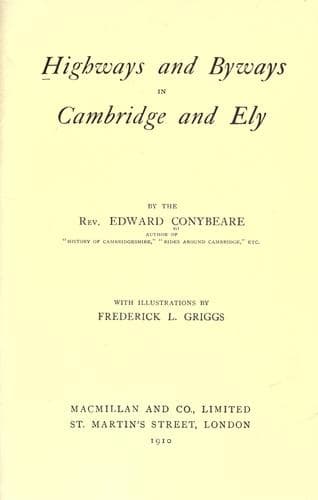
Highways and Byways in Cambridge and ElyConybeare, John William Edward
History
Highways and Byways in Cambridge and Ely
Conybeare, John William Edward
Cambridgeshire (England) -- Description and travel; Isle of Ely (England) -- Description and travel
The punishment was that sudden and disastrous Danish inroad which
overwhelmed the whole of the kingdom, and drove Alfred himself into
hiding at Athelney. While he was there St. Neot died at the
neighbouring Glastonbury. We read there, ere his departure, the saint
had promised that as he had been Alfred's spiritual guide in life, so
should that spiritual guidance and wardship still abide with him.
"Thy guide have I been ever; thee and thine will I lead on." "I will
be thy captain, I will be thy champion; thou shalt be glad and rejoice
in me." "Lo, I will go before thy banner; thine enemies shall perish
at my presence." And when, a few weeks later, the King led on his
forces to the crowning victory over the Danes at Ethandune, he was
persuaded that this promise was being fulfilled. With the eye of
ardent faith he beheld the blessed spirit of his brother leading on
the Christian banners to the onset. "See ye not?" he exclaimed to his
men, "See ye not? That is indeed Neotus, Christ's glorious servant,
Christ's unconquered soldier; and through him is the victory even now
given to our hands."
Thus it came about that St. Neot remained the object of unforgotten
reverence, not only to Alfred himself, but to his heroic son and
daughter. The former christened after this sainted uncle his own
eldest son Athelstane, afterwards "Athelstane the Magnificent," the
mighty King of the English and Emperor of Britain; and when the latter
delivered Mercia from the yoke of the Danes, she called by his name
one of the fortress towns, which she founded on the Ouse to keep them
in check, St. Neots.
It is appropriate that one of the earliest and most spirited of the
Chronicles that record the great deeds of Alfred should have been
preserved for five centuries in the Church of St. Neots, and should
still be known as the "Chronicle of St. Neots."[189] The north aisle
of this church is known as the "Jesus Chapel," having been built by a
local mediaeval fraternity called "The Guild of Jesus." The sacred
monogram IHC, is to be seen on the beams of the roof inside and on the
buttresses outside.
[Footnote 189: To this Chronicle we owe some of the best known legends
in English History, the story of Alfred and the cakes, for instance.
It was probably written in the tenth century. (See my "Alfred in the
Chroniclers.")]
* * * * *
One of the most delightful routes of the district is that by which we
make our way along the Ouse from St. Neots to Ely, by way of
Godmanchester, Huntingdon, and St. Ives. On leaving St. Neots the road
climbs Paxton Hill, where its shady course overhangs a beautiful sweep
of the broad stream 120 feet below. Thence it drops to the river at
Paxton itself, where the church has some good Saxon features, and
thence continues along the water to the twin villages of Offord Darcy
and Offord Cluny, close together on the right bank, and so over
another little eminence to strike the river again at Godmanchester.
Public-domain text, read in full here on John Shaqi.
Reviews
Reviews
No reviews yet
Be the first to share your thoughts on this work.
Elsewhere in the archive
Join the Discussion
Join the discussion
Sign in to leave a comment or review.
Sign InorCreate an account