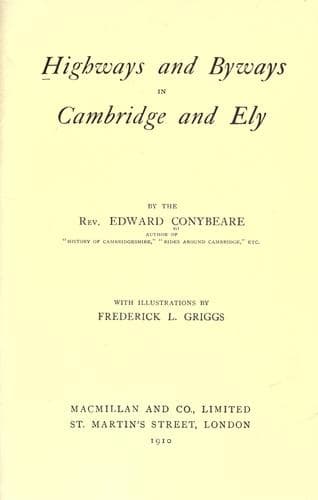
Highways and Byways in Cambridge and ElyConybeare, John William Edward
History
Highways and Byways in Cambridge and Ely
Conybeare, John William Edward
Cambridgeshire (England) -- Description and travel; Isle of Ely (England) -- Description and travel
"We do in the presence of the Lord Jesus, the awful crowned King
of Sion, and in the presence of his holy angels and people and
all besides here present, solemnly give up ourselves to the Lord
and to one another, by the will of God, solemnly promising and
engaging in the aforesaid presence to walk with the Lord and with
one another in the observation of all Gospel ordinances, and the
discharge of all relative duties in this church of God and
elsewhere, as the Lord shall enlighten us and enable us."[194]
[Footnote 194: _Cambs. Monthly Repository X._]
His efforts were vigorously seconded by Oddy and Oasland, whose
consciences, like his own, would not permit them to use the Anglican
Prayer Book; and the units of this embryo Church, who were often
spoken of at the time as "Mr. Holcroft's disciples," became widely
spread throughout the county. Already, before the end of 1662, they
had regular meetings at Barrington, Eversden, Waterbeach, and Guyhirn,
as well as Cambridge; and when, ten years later, they became licensed
by the King's Proclamation of Indulgence, we find the number increased
fourfold. So far Nonconformity had been the only bond between these
scattered bands of worshippers; but they now began to differentiate
themselves into Baptist, Independent, and Presbyterian Congregations,
though the lines were not as yet sharply drawn, and, indeed, are not
even now sharply drawn in the country villages, where a man is
"Church" or "Chapel," caring little what may be the precise
denomination of his chapel. The strength of the Dissenting spirit thus
implanted at Oakington may be measured by that of the language
employed by the zealous Archdeacon of Ely, who, in 1685, declares this
to be "the most scandalous parish and the worst in the diocese. The
people most vile. A Fanatic Schoolmaster."
From Oakington the lane leads on to Long Stanton, where the two
churches of St. Michael and All Saints are both noteworthy. The former
is a simple Early English building with a _thatched_ roof (till lately
made of reeds from the fen, a far more durable material than straw,
but now unobtainable), a rich double piscina, and an oak chest dating
from the twelfth century. The latter, at the other end of the "long"
village street, is a Decorated cruciform structure, the south transept
having become the mortuary chapel of the Hatton family, who bought the
lordship of the manor from Queen Elizabeth.
Public-domain text, read in full here on John Shaqi.
Reviews
Reviews
No reviews yet
Be the first to share your thoughts on this work.
Elsewhere in the archive
Join the Discussion
Join the discussion
Sign in to leave a comment or review.
Sign InorCreate an account