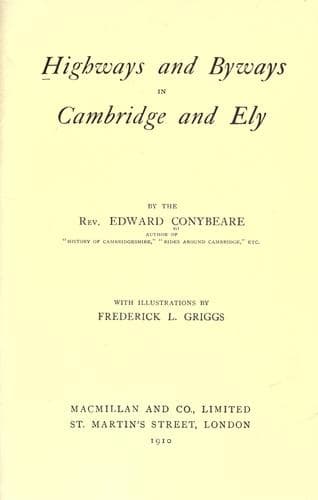
Highways and Byways in Cambridge and ElyConybeare, John William Edward
History
Highways and Byways in Cambridge and Ely
Conybeare, John William Edward
Cambridgeshire (England) -- Description and travel; Isle of Ely (England) -- Description and travel
In looking southward from Sutton Church, three steeples are specially
conspicuous in the Ouse valley. They are those of Over, Swavesey, and
Willingham. All are churches of the first class, and all are best
reached from Cambridge by way of the Via Devana, which, after crossing
the "Great Bridge" and climbing the ascent past the Castle, continues
its straight course to the north-west under the designation of the
Huntingdon Road. Just as it leaves the town a branch-road on the right
leads to the village of Histon, which the jam factories of Messrs.
Chivers have made one of the most flourishing in the county. The
church here has some good Early English work, and a remarkable "Rood"
(much defaced) on the gable of the S. transept. This is an almost
unique example of the early "Majestas" type of crucifix (p. 339).
Christ, with outspread arms, wears, not the Crown of Thorns, but the
Old English "king-helm," and is fully robed. About 1200 this ideal
type gave place to the later "realistic" crucifix.
[Illustration: _Sutton Church._]
A mile beyond the last houses of Cambridge the Via Devana comes to the
huge red-brick mass of Girton College, which has been already spoken
of.[193] Its spacious grounds and never-ending corridors impress the
mind with admiration for the enthusiasm and energy which has thus
materialised Tennyson's vision of University education for women. At
this point another northward turn takes us to Girton Church, where
there are good brasses to two successive fifteenth century parsons. In
their day the living belonged to Ramsey Abbey, by the gift of Eric,
Bishop of Dorchester (1016). We next come to Oakington, the Mecca of
Cambridgeshire Free Churchmen. For here, in the quiet little
Nonconformist Cemetery, rest, side by side, the three men to whom the
chief sects of the county trace their spiritual ancestry--Francis
Holcroft, Joseph Oddy, and Henry Oasland.
[Footnote 193: See p. 144.]
The first named was a Fellow of Clare College where he had for his
"chum" (_i.e._ chamber-mate, as we find the word used in "Pickwick")
Tillotson, the future Archbishop of Canterbury. He began his
ministerial career by taking on himself to supply the place of a
brother collegian, the Puritan minister in charge of Littlington, near
Royston, who, most un-Puritanically, was often incapacitated by drink
from performing his duties. Later, in 1655, when still only
twenty-two, he himself became pastor of the adjoining parish of
Bassingbourn. When the "Black Bartholomew" of 1662 deprived him of
this charge under the Act of Uniformity, he preached, at the risk of
fine and imprisonment, throughout the neighbourhood, binding together
his adherents in a loosely-knit organisation, whose members were
admitted on subscribing the following Profession of Faith:
Public-domain text, read in full here on John Shaqi.
Reviews
Reviews
No reviews yet
Be the first to share your thoughts on this work.
Elsewhere in the archive
Join the Discussion
Join the discussion
Sign in to leave a comment or review.
Sign InorCreate an account