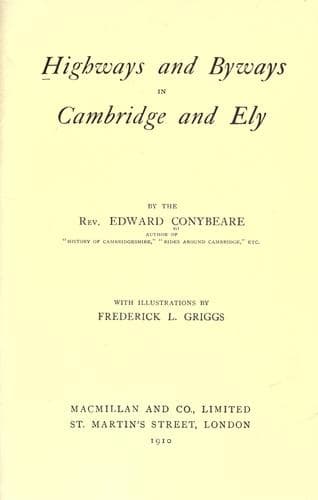
Highways and Byways in Cambridge and ElyConybeare, John William Edward
History
Highways and Byways in Cambridge and Ely
Conybeare, John William Edward
Cambridgeshire (England) -- Description and travel; Isle of Ely (England) -- Description and travel
Formerly, as we have said, the regular road from Cambridge to Ely was
by way of the Causeway at Aldreth. But this roundabout route of over
twenty miles compared unfavourably with the shorter line taken by the
Cam, which was accordingly the favourite for such as could afford
boat-hire. In the eighteenth century regular packet-boats ran daily
between the two places, drawn by horses. To-day the only passengers on
the river are pleasure-seekers, and the ordinary way to Ely from
Cambridge is by the road supposed to represent the hypothetical Akeman
Street of Roman days.[200] This road turns northwards round Magdalene
College, and runs through the suburb of New Chesterton. Old Chesterton
stands on the river, east of the road, and has a finely-proportioned
steeple, with particularly melodious bells, and a slender spire. At
this point is the winning-post of the College boat races.[201] On the
opposite bank, a mile lower down the stream, is Fen Ditton, the "Ditch
End" where the Fleam Dyke strikes the river.[202] Ditton Corner, just
beneath the parish church, is the favourite spot for seeing these
races, as it commands a view of two long reaches, and is also (as a
bend in the stream must needs be) a highly probable spot for bumps.
[Footnote 200: See p. 252.]
[Footnote 201: See p. 146].
[Footnote 202: See p. 170.]
Leaving these to the right, we reach Milton, whence the poet's family
name is said to be derived, and where the church has seventeenth
century altar rails, a very rare possession. Just opposite, with a
ferry between, is Horningsea, where there is another good church.
Between this and Fen Ditton is an ancient building, now used for farm
purposes, which the Ordnance Map marks as "Biggin Abbey." An abbey,
however, it never was, being only one (and the smallest) of the many
scattered mansions of the Abbot and Bishop of Ely. On the stream
beside it is Baitsbite Lock, the starting-point of the boat races.
Here along the towing path may be seen the posts, set at regular
intervals on the brink of the stream, to which each boat is moored by
the "starting cord" held in the coxswain's[203] hand. He must not let
it go till the gun is fired. Thrilling moments pass while he counts
aloud the last seconds--"five ... four ... three ... two ... one," and
the muscles of the crew grow ever tenser, till, at the signal, he
flings the cord into the water, and every oar strains its utmost in
the first stroke.
[Footnote 203: This word is invariably abbreviated to "Cox," which is
also used as a verb.]
[Illustration: _Swavesey._]
Public-domain text, read in full here on John Shaqi.
Reviews
Reviews
No reviews yet
Be the first to share your thoughts on this work.
Elsewhere in the archive
Join the Discussion
Join the discussion
Sign in to leave a comment or review.
Sign InorCreate an account