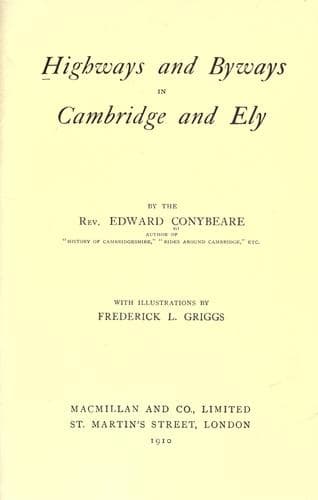
Highways and Byways in Cambridge and ElyConybeare, John William Edward
History
Highways and Byways in Cambridge and Ely
Conybeare, John William Edward
Cambridgeshire (England) -- Description and travel; Isle of Ely (England) -- Description and travel
The next lock is Clayhithe, two miles further down the river, with an
inn beside it in special favour for Cambridge boating pic-nics. Here,
too, is the lowest bridge over the Cam, indeed the only one below
Cambridge. It belongs to a private company, and is rigorously tolled.
A pretty shady lane leads to it from Horningsea. Hard by, on the left
bank, are the villages of Waterbeach and Landbeach. They are
respectively four and twelve furlongs from the stream, and mark
successive boundaries of the fenland waters. Between them runs an
ancient earthwork, the Car Dyke (probably of Roman date), which of old
kept those waters in flood time from drowning the meadows to the
south. Starting from the Cam at Clayhithe it runs along the whole
western limit of the fenland. It reaches the Ouse near the large
village of Cottenham (where the east window of the fourteenth century
church is copied from one in Prior Crauden's Chapel at Ely) with over
2,000 inhabitants, and goes on past the tiny and picturesque Rampton,
with under 200, to Willingham and Earith, Ramsey and Peterborough,
Deeping and Sleaford; finally ending its long course on the banks of
the far off Witham, hard by Lincoln.
[Illustration: _Swavesey Church._]
For a mile or so our "Akeman Street" follows the course of the Car
Dyke, and then strikes northward across the fen, along a causeway of
its own, passing near the remains of Denny Abbey, a small foundation
which passed through unusual vicissitudes. Originally a Benedictine
House, it was transferred in the twelfth century to the Templars, and
in 1290, passed from them to the Minor Sisters of the Franciscan
order. Marie de Valence, the foundress of Pembroke College, was a
noted benefactress to Denny, and in her statutes solemnly enjoined on
the scholars of the former institution "kindness" towards the recluses
of the latter. The abbey is now a farm, but there are more remains of
the monastic buildings here than almost anywhere else in the county.
Much of the church is built into the farm house, and the refectory is
in use as a barn. Many old walls and dykes may be traced, while a
large entrenchment to the south is known as "Soldiers' Hill." This
name may be due to the Templars.
Public-domain text, read in full here on John Shaqi.
Reviews
Reviews
No reviews yet
Be the first to share your thoughts on this work.
Elsewhere in the archive
Join the Discussion
Join the discussion
Sign in to leave a comment or review.
Sign InorCreate an account