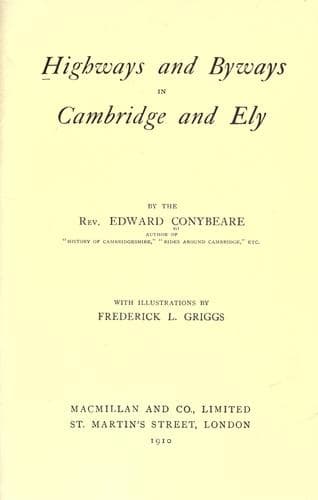
Highways and Byways in Cambridge and ElyConybeare, John William Edward
History
Highways and Byways in Cambridge and Ely
Conybeare, John William Edward
Cambridgeshire (England) -- Description and travel; Isle of Ely (England) -- Description and travel
The city of Ely has a population approaching 8,000, and stands on the
western edge of the Island of Ely, once truly an island, being an area
of dry land rising from the midst of the fens, and, till their
drainage, accessible only by boat or causeway. This _Island_, a true
bit of natural _terra firma_, measures about eight miles by six, and
lies at the southern end of a much more extensive fenland
archipelago, of irregular shape, measuring approximately thirty miles
by twenty, known from of old as the _Isle_ of Ely. The waters of the
Fen, which, so lately as a century ago, made this wide area an
archipelago indeed, have now given place to a "boundless plain" of
fertile corn-land, so rich in harvests as to be often called "The
Golden Plain of England."
A twelfth century chronicler, the writer of the "Liber Eliensis,"
asserts that, within the first years of the seventh century A.D.,
Ethelbert, King of Kent, newly converted to Christianity, founded a
monastery at Cratendune, about a mile south of Ely, and that Saint
Augustine, the first Archbishop of Canterbury, consecrated it. But we
cannot say that the authentic history of Ely begins till seventy years
later, when we see an Anglo-Saxon lady founding a monastery on this
rising ground in the midst of the Fens. The lady is Etheldreda, once
Queen of Northumbria; her monastery is known to us as Ely. She is the
daughter of Anna, King of East Anglia, who had reigned at Exning,
almost within sight of Ely.
King Anna was a devout man, who himself died a hero's death, fighting
for the Cross and for his country against the overwhelming onset of
Penda, the heathen King of Mercia, who made it the object of his life
to stamp out English Christianity. But, though Anna fell, his cause
triumphed. Penda shortly died, and his work perished with him. Not so
Anna's. After his death the tide of Christian progress ran the
stronger; and all over England it was through members of his family
that it was specially championed.
Public-domain text, read in full here on John Shaqi.
Reviews
Reviews
No reviews yet
Be the first to share your thoughts on this work.
Elsewhere in the archive
Join the Discussion
Join the discussion
Sign in to leave a comment or review.
Sign InorCreate an account