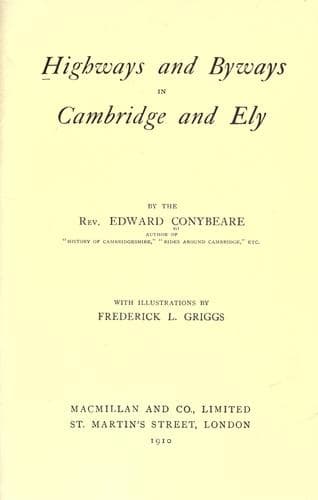
Highways and Byways in Cambridge and ElyConybeare, John William Edward
History
Highways and Byways in Cambridge and Ely
Conybeare, John William Edward
Cambridgeshire (England) -- Description and travel; Isle of Ely (England) -- Description and travel
Married to the King of Northumbria, his daughter Queen Etheldreda had
renounced her husband and her northern kingdom, and had returned to
her native Fenland, there to found a monastery for both monks and
nuns. In taking this step she had been influenced by two persons of
note; by St. Hilda, her aunt, the foundress and first Abbess of
Whitby, and by St. Wilfrid, Bishop of York. Hilda had in early life
gained a firm hold on the heart of her niece, who had become fired
with the wish to follow her example and herself to found a monastery.
In spite of this resolve, of which she made no secret, she had been
forced (while strongly protesting) into a nominal marriage with
Egfrid, the youthful King of Northumbria. After twelve years of
unhappy life, she had been induced by St. Wilfrid to quit her
husband; from St. Wilfrid's hand she had received the veil, before him
she had taken the vows that bound her to a monastic life. It is a
strange, unnatural tale, that cannot claim our approval; but there it
is, and its truth is not questioned.
Queen Etheldreda, accompanied by certain attendants had then fled
southward, with her deeply wronged husband in chase. She had been
sheltered on one occasion from his pursuit by a tide of unprecedented
height, which protected her on a rocky hiding-place while the King
passed by, all unaware that he was close to her. At length she had
reached her own fenland country; and here, still following Hilda's
example, she set herself to build a monastery, choosing the highest
ground available. She was a well dowered lady, for her first husband,
Tonbert, was a Prince of the Girvii, a Celtic tribe descended from
those refugee Britons who had sought safety in the fens when all else
was conquered by the English invaders two centuries earlier. This
prince had bequeathed to his childless widow all his wide fenland
domains; so Etheldreda had no need to seek further for an endowment
for her monastery; while her brother Adwulf, now King of East Anglia,
defrayed the cost of the new buildings. These ere long became the home
of both monks and nuns, who lived in separate houses and met only for
their common worship in the Abbey church. No Abbot was appointed, but
Etheldreda herself was their Abbess, ruling both sexes alike.
It is probable that from its foundation the monastery at Ely was under
the influence of the rule of St. Benedict, for St. Wilfrid during
Etheldreda's life-time was a frequent resident there, and he was in
close touch with St. Botolph, that most influential, though half
legendary saint, who, from his hermitage at Ickenhoe in Suffolk, was
introducing throughout East Anglia the rule of the monks of St.
Benedict, those great preservers of civilisation, which, but for them,
must in many lands have perished, when the strong hand of the Roman
Empire lost its grip.
[Illustration: _The North Triforium of the Nave, Ely._]
Public-domain text, read in full here on John Shaqi.
Reviews
Reviews
No reviews yet
Be the first to share your thoughts on this work.
Elsewhere in the archive
Join the Discussion
Join the discussion
Sign in to leave a comment or review.
Sign InorCreate an account