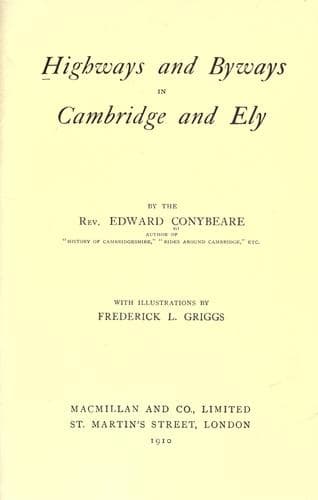
Highways and Byways in Cambridge and ElyConybeare, John William Edward
History
Highways and Byways in Cambridge and Ely
Conybeare, John William Edward
Cambridgeshire (England) -- Description and travel; Isle of Ely (England) -- Description and travel
St. Etheldreda was long remembered with affection, and was commonly
spoken of as St. Audrey. The popular Pilgrims' Fair held at Ely was
known at St. Audrey's Fair; and the cheap fairings bought and sold
there (especially the coloured necklets of fine silk known as "St.
Audrey's chains") were called, from her name, "tawdry"; and thus a new
word was coined for us with a strange story of its own, a word hardly
worthy of the great Abbess of the Fenland to whom it owes its origin.
Centuries later, St. Audrey's Fair, held in October, had grown to be
one of the most important in the land, lasting for a fortnight. By the
year 1248 it had become such a centre of merchandise as to interfere
with the traffic of the Fair which Henry the Third had lately
established at Westminster in honour of St. Edward the Confessor; the
King therefore issued a warrant interdicting the fair at Ely. This
suspension meant serious loss to the Bishop, Hugh de Northwold, "who
made a heavy complaint to the King concerning the matter, but he
gained from him nothing except words of soothing promises of future
consolation," says the chronicler.
For two hundred years after the death of the foundress, the abbey of
monks and nuns went on with its pious works and ways. Then, in 870,
appeared the Danes, still pagans; and after working their way through
Yorkshire and Lincolnshire, where they "wasted with fire and sword all
that ever they came to, they brake down all the abbeys of the fens;
nor did Ely, so famous of old, escape." Having laid waste
Peterborough, then known as Medhampsted, they came across the fens to
Ely. The abbey and all the buildings pertaining to it were burnt; the
monks and nuns put to the sword. Before setting fire to the buildings
the Danes had secured for themselves all they contained of value, and
great was the store, for the people of the neighbourhood had brought
their goods into the monastery as to a place of safety. All was seized
by the invaders, and what they could not carry away they destroyed.
Thus Etheldreda's Abbey, after lasting 200 years, was left a deserted
ruin; but her coffin of stone escaped without injury. One of the
depredators, indeed, is said to have made an attempt to break into it,
with the result that his eyes started from his head, and then and
there he died, as the chronicler relates. The ancient sarcophagus had
proved worthy of its trust.
Public-domain text, read in full here on John Shaqi.
Reviews
Reviews
No reviews yet
Be the first to share your thoughts on this work.
Elsewhere in the archive
Join the Discussion
Join the discussion
Sign in to leave a comment or review.
Sign InorCreate an account