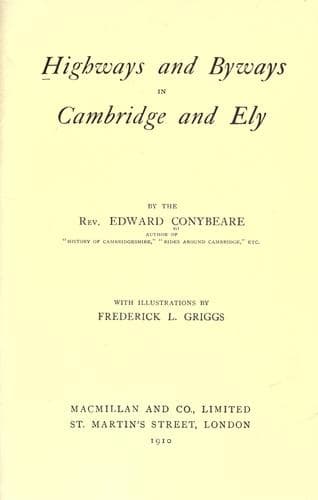
Highways and Byways in Cambridge and ElyConybeare, John William Edward
History
Highways and Byways in Cambridge and Ely
Conybeare, John William Edward
Cambridgeshire (England) -- Description and travel; Isle of Ely (England) -- Description and travel
In the year 970, on the Feast of the Purification, a day that we shall
again find eventful in the annals of Ely, the new and restored
monastic buildings were consecrated by Dunstan, who now, as Archbishop
of Canterbury, filled the highest office in the Church of the land.
The chronicler, Roger of Wendover, tells us how, by Dunstan's counsel,
King Edgar "everywhere restrained the rashness of the wicked,
cherished the just and modest, restored and enriched the desolate
churches of God, gathered multitudes of monks and nuns to praise and
glorify the Great Creator, and built more than forty monasteries."
This shews us that, the events taking place at Ely were in no sense
isolated, but were part of a great revival going on throughout the
whole country.
In the year 991 the restored Abbey becomes connected with one of the
most stirring poems of the English language, the "Song of Maldon." The
Danish invasions, which had been checked for a century by the glorious
line of monarchs who inherited King Alfred's blood and energy, were
beginning again. One of these pirate hordes had landed in East Anglia,
now no longer a separate principality but merely a district of the
United Kingdom of England, governed by an "Alderman" named Brithnoth.
Ethelred, surnamed the Unready, was on the throne--a King who for his
lack of good judgment well deserved this contemptuous sobriquet--and
his want of energy and capacity threw on to the shoulders of his
subordinates the burden of the defence of his realm.
Brithnoth rose to the emergency, as a true Christian hero. At the head
of his retainers he hurried to meet the foe, calling out the local
levies to join his march. At Ely, as he hastened past, he, with his
men, was royally entertained. The day before, when he was passing
Ramsey Abbey, the Abbot had offered him hospitality, but only for
himself and half a dozen picked friends. This niggardly invitation
drew from Brithnoth a scornful answer: "Tell my Lord Abbot," he
replied, "that I cannot fight without my men, neither will I feed
without them." At Ely meat and drink were placed before leader and
followers without distinction, and well were the monks rewarded, for
Brithnoth requited their hospitality by the gift of no fewer than nine
manors, all lying near Cambridge--Trumpington, Fulbourn, and
others--stipulating only that, if slain in battle, his body should be
brought back to their church for burial.
At Maldon in Essex on the River Panta (or Blackwater, as it is now
called), he met the Danes, who began by sending a herald demanding a
ransom, to be fixed by themselves, as the price of peace:
"Then back with our booty
To ship will we get us,
Fare forth on the flood,
And pass you in peace."
This degrading offer Brithnoth contemptuously refuses:
"For ransom we give you
Full freely our weapons,
Spear-edge and sword-edge
Of old renown."
The Danes at once make their way across the river and attack the
English levies:
Public-domain text, read in full here on John Shaqi.
Reviews
Reviews
No reviews yet
Be the first to share your thoughts on this work.
Elsewhere in the archive
Join the Discussion
Join the discussion
Sign in to leave a comment or review.
Sign InorCreate an account