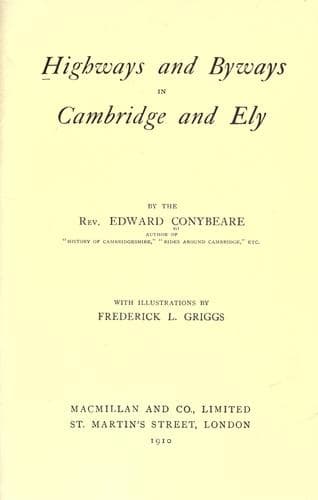
Highways and Byways in Cambridge and ElyConybeare, John William Edward
History
Highways and Byways in Cambridge and Ely
Conybeare, John William Edward
Cambridgeshire (England) -- Description and travel; Isle of Ely (England) -- Description and travel
"Then drave from each hand
Full starkly the spear,
Showered the sharp arrows,
Busy were bows,
Shield met shaft,
Bitter the battle."
In the end the pirates are driven back to their ships, but at the cost
of Brithnoth's own life. He is pierced by a spear, and sinks dying to
the ground; to the last exhorting his soldiers to fight on, and
commending his own soul to God in the following beautiful and touching
lines:
"To Thee give I thanks,
Thou Lord of all living,
For all good hap
In this life here.
Sore need I now,
O Maker mild,
That Thou should'st grant
My spirit grace;
That my soul to Thee
May depart in peace,
And flee to Thy keeping,
Thou King of Angels.
To Thee do I pray
That the Gates of Hell
Prevail not against me."
[Illustration: _West Aisle of the North Transept, Ely._]
The Danes carried off Brithnoth's head; but his body was rescued; and,
according to his wish, the monks came and brought it back to Ely,
where the Abbot buried it, replacing the missing head by one of wax.
During the eighteenth century the skeleton was met with in the course
of some excavations and recognised as Brithnoth's by the absence of
the skull. It now lies in Bishop West's beautiful chapel, along with
the bones of other Anglo-Saxon worthies.
The Lady Elfleda, Brithnoth's widow, added largely to the benefactions
he had bestowed on Ely; she gave the Abbey valuable lands within easy
reach of the monastery, and she moreover presented to the church a
golden chain, and a curtain worked with the most notable deeds of her
husband's life. Those who have seen the Bayeux tapestry, representing
the events of the life of William the Conqueror, can picture to
themselves what Lady Elfleda's curtain may have been a century
earlier.
In the next generation (1016) a body of the monks of Ely accompanied
another hero to battle against the Danes. The hero of this generation
was Ethelred's son, King Edmund Ironside; the battle was the great
fight of Assandun, a place impossible to locate with certainty, but
not improbably situated on the south-east border of Cambridgeshire.
During the last twenty-five years the Danes had become more and more
daring, and now, under their great king, Canute, the mightiest of all
Scandinavian monarchs, they were attempting nothing less than the
organised conquest of England. Thus Canute and Edmund were face to
face in a desperate struggle, and, after five indecisive battles in a
single year, Edmund was defeated, on St. Luke's Day, at Assandun, and
his defeat was shortly followed by his death. Canute then assumed the
crown, by right of conquest, a right which he proclaimed by calling
himself not, like his predecessors, "King of the English," but "King
of England."
Public-domain text, read in full here on John Shaqi.
Reviews
Reviews
No reviews yet
Be the first to share your thoughts on this work.
Elsewhere in the archive
Join the Discussion
Join the discussion
Sign in to leave a comment or review.
Sign InorCreate an account