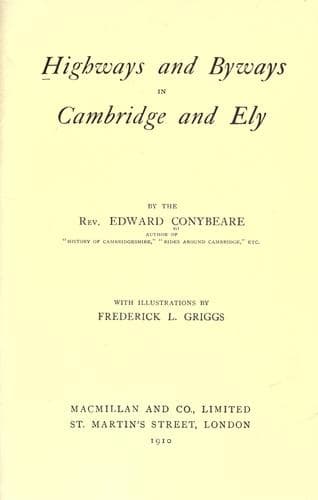
Highways and Byways in Cambridge and ElyConybeare, John William Edward
History
Highways and Byways in Cambridge and Ely
Conybeare, John William Edward
Cambridgeshire (England) -- Description and travel; Isle of Ely (England) -- Description and travel
After the death of Canute in 1035, it became a question whether this
same Alfred, "the Etheling" (_i.e._ Prince), Emma's eldest son by
Ethelred, now a man of over thirty, or Harthacnut, her only son by
Canute, a boy of sixteen, or one Harold, who, though not an Etheling,
claimed to be Canute's eldest son, should be chosen King of England.
Harold, in spite of grave doubts as to his paternity, "had all the
cry"; and when Alfred, "the innocent Etheling," made an attempt to
protect his widowed mother against the new King's oppression, he was
sent as a prisoner by ship to Ely. Before being landed his eyes were
put out, in a manner so brutal that he shortly died of the shock, to
find a grave in the Abbey church under its western tower. The
Anglo-Saxon Chronicler records this crime in a pathetic ballad,
denouncing it as even beyond the horrors of the Danish wars:
"Nor was drearier deed
Done in this land,
Since Danes first came."
That no blame need be attached to the monks of Ely for this atrocity
is indicated by the fact that, when Alfred's brother, Edward the
Confessor, came to the throne, he confirmed all their ancient
charters, granting lands and privileges to the Abbey, and himself
became a benefactor to the place of his education.
With the Norman invasion, Ely again becomes a centre of war. Led by
Christian the Bishop, and Osbiorn the Earl, a force of Danish
adventurers had appeared in the Humber, professing to be the allies of
the English in their struggle with the Normans. Their real object was
to place their own King Sweyn, the nephew of Canute, on the throne of
England, and, if foiled in this purpose, at least to enrich themselves
with England's plunder. After partaking in scenes of devastation in
Yorkshire, they sailed southward till they reached Ely, where they
took up their quarters. Here the fenland folk forgathered with them,
for the Norman was a more thoroughgoing oppressor than any Dane; and,
in especial, the "strenuous" outlaw Hereward "the Wake" joined them
"with his gang."
To show their zeal against the French--and to indulge their lust of
plunder--they set off, by water, to Peterborough, where the Abbey had
been recently conferred on a Norman ruffian named Thorold. To save
this good old English foundation from such degrading occupancy,
Hereward, as their guide, led them on, first to sack and then to burn
it to the ground. The Danes, having got their booty, promptly sailed
away, while Hereward returned to Ely, there to make his memorable
stand against William and the Normans. Fiction may have embroidered
the tale of his prowess; but there remains a foundation of truth, even
after the superstructure of romance has been removed. At Ely were now
gathered together to him a mixed company of fugitives; misfortune,
according to her repute, making strange bed-fellows.
Public-domain text, read in full here on John Shaqi.
Reviews
Reviews
No reviews yet
Be the first to share your thoughts on this work.
Elsewhere in the archive
Join the Discussion
Join the discussion
Sign in to leave a comment or review.
Sign InorCreate an account