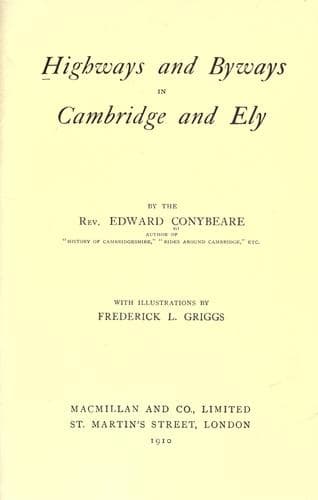
Highways and Byways in Cambridge and ElyConybeare, John William Edward
History
Highways and Byways in Cambridge and Ely
Conybeare, John William Edward
Cambridgeshire (England) -- Description and travel; Isle of Ely (England) -- Description and travel
When William had conquered at Hastings, England, as a whole, was at
first disposed to accept the verdict of battle, and to acknowledge
his claim to the throne, as it had acknowledged Canute's. But when the
necessities of his position, as the captain of an invading army,
forced him to confiscate every estate in England (except the Church
lands), and to bestow it on some Norman adventurer; when every single
Englishman in high office, Sheriff and Alderman, Bishop and Abbot, was
turned out to make room for a Frenchman,[211] the whole nation glowed
with outraged patriotism, and Ely seemed likely to become a second
Athelney, whence the spark of resistance to the tyrant might spread
like wildfire throughout the length and breadth of the land.
[Footnote 211: See my _History of Cambridgeshire_.]
And had there been a second Alfred this might well have actually come
to pass. As it was, many of the magnates who could not brook
submission retired to the "Camp of Refuge," as the Island of Ely now
got to be called. This fastness, being surrounded on all sides by deep
fens "as by a strong wall," promised them a sure retreat, and for a
while enabled them to baffle all the efforts even of the mighty
Conqueror to subdue them. Thither came Archbishop Stigand (deposed by
the Conqueror to make way for the great Lanfranc); thither came the
Abbot of St. Albans, thither came the valiant Ethelnoth, Bishop of
Durham; thither came Morcar, the last Earl of Northumbria, "with many
a hundred more," both clergy and laity. Here they received shelter and
hospitality from Thurstan, the last of the English Abbots of Ely.
By the general voice Hereward was chosen as their captain, and
fortified the island against the Conqueror. William, on hearing of
this, hastened to Cambridge with his whole army, and invested the
place (so far as it was possible to invest it) both by land and water,
building a castle at Wisbech on the north, and at Reach on the south.
At Aldreth, where scarcely a mile of fen parted the Island from the
mainland at Willingham, he made a floating bridge of trees and
faggots, fastened underneath with cow-hides; but when his men
attempted to cross it, the unsteady structure capsized, and that
portion of the army engaged in the attempt was drowned.
Perplexed and almost daunted, William, with his court and army,
retired for a time to Brandon in Suffolk; while the refugees at Ely
spent stirring days. The knights and churchmen were hospitably
entertained in the refectory of the abbey, every man with his shield
and lance hanging near him, to be ready in case of sudden alarm. Their
days were diversified by raids into the surrounding country beyond the
fens, to snatch what provisions they could for their fastness; and
these raids of the islanders were so dreaded throughout the district,
that its inhabitants were thankful for the protection of William's
soldiery.
Public-domain text, read in full here on John Shaqi.
Reviews
Reviews
No reviews yet
Be the first to share your thoughts on this work.
Elsewhere in the archive
Join the Discussion
Join the discussion
Sign in to leave a comment or review.
Sign InorCreate an account