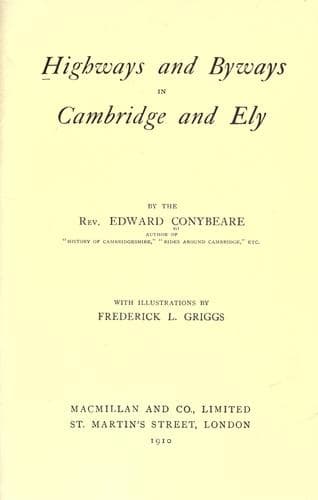
Highways and Byways in Cambridge and ElyConybeare, John William Edward
History
Highways and Byways in Cambridge and Ely
Conybeare, John William Edward
Cambridgeshire (England) -- Description and travel; Isle of Ely (England) -- Description and travel
Hereward, according to the legend, hearing that another attack was
imminent, followed the example of Alfred the Great by betaking himself
in disguise to Brandon to learn the King's designs. He found that
William, by a judicious mixture of severity and conciliation, had won
over a certain number of the outlying fen-folk, and had imposed upon
them the task of conveying a great store of wood and faggots for him
to Aldreth, with which to construct there a causeway once more.
Hereupon Hereward, still in his disguise, feigned that he was himself
one of these traitors to England, and eager above all the others to
help the Conqueror against the marauding thieves of the Camp of
Refuge. It was he who was foremost in collecting faggots for the
wood-pile at Aldreth, and then, when all was gathered, who was it but
Hereward that set it on fire so that all was lost? And once more, when
the besiegers were making a third attempt to gain the island, under
the auspices of a reputed witch whom the pious William deigned to
employ for the sustaining of his men's sunken courage, it was Hereward
who fired the reed-beds through which the foe was advancing, so that
the whole column, witch and all, were involved in one common
destruction.
Finally William, finding that he could not reduce the island by force,
resolved to bring it under by political pressure, and threatened to
grant to his supporters all the Abbey lands within his power. On
hearing this the Abbot and monks resolved to surrender, and they sent
secret messengers to William, who was at Warwick, offering to submit
to him on condition that he would spare the possessions of the Abbey.
To this the King consented; and during Hereward's absence from Ely on
a foraging expedition, he landed without resistance on the fen-girt
island. Hereward on his return found that all was lost, and himself
barely escaped with a few followers, to live on as outlaws in the
greenwood for a few desperate years, till at length he, too, "came
in," and was granted "the King's peace."
On William's unopposed success through their connivance the monks
fondly imagined that they had something to expect from his gratitude,
and were preparing a formal welcome and act of submission when it
should please him to visit the abbey church in thanksgiving for his
victory. William, however, had other designs, and paid his visit
without notice, at an hour when he knew that the brethren would be in
the refectory at dinner. He stood alone before the High Altar, and
casting upon it a single mark of gold, equivalent to about L150,
quietly departed.
Public-domain text, read in full here on John Shaqi.
Reviews
Reviews
No reviews yet
Be the first to share your thoughts on this work.
Elsewhere in the archive
Join the Discussion
Join the discussion
Sign in to leave a comment or review.
Sign InorCreate an account