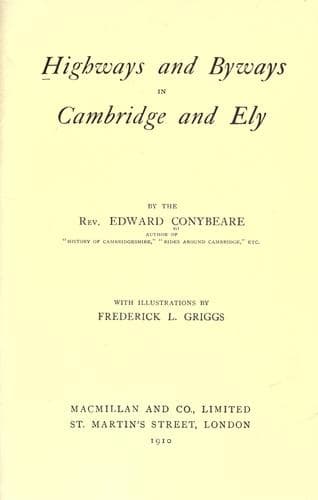
Highways and Byways in Cambridge and ElyConybeare, John William Edward
History
Highways and Byways in Cambridge and Ely
Conybeare, John William Edward
Cambridgeshire (England) -- Description and travel; Isle of Ely (England) -- Description and travel
For an event of even greater moment than the building of the church
took place about this time. Early in the twelfth century, in order to
quell some dispute that had arisen as to the authority of the Bishop
of Lincoln over the Abbot of Ely, the Pope had consented, at the
request of King Henry the First and Archbishop Anselm, that the Abbot
of Ely should become a Bishop, with the Isle of Ely and the County of
Cambridge as his See.[213] More than 700 years went by before any
change was made in the extent of the diocese thus created; for it was
not till 1837 that the counties of Huntingdon and Bedford and the
western half of Suffolk were added to it.
[Footnote 213: The county, at this time, comprised only the district
south of the Isle. This ecclesiastical connection between it and the
Isle was the first towards their later unification. See p. 8.]
We owe to the creation of this Bishopric the very existence of Ely
Minster as it now stands; had it remained merely an abbey, instead of
being also a cathedral, it would have perished at the Reformation,
along with the yet greater church at Bury St. Edmund's not far away,
and with many another sister abbey throughout the land. At Ely, too,
we should see before us ruined arches open to the sky, beautiful
indeed and pathetic, but no longer a centre of worship. To this day
the Bishop of Ely sits in his cathedral not as Bishop but as Abbot;
not at the south-eastern but at the south-western end of the choir
stalls, while the Dean occupies the seat once belonging to the Prior
at the north-western end. Richard, as we have said, was the last of
the Abbots of Ely who were Abbots and nothing else. Hervey, appointed
in 1109, was the first Bishop-Abbot. He had already been Bishop of
Bangor, whence he had been driven by a Welsh revolt.
This may be the place to say something of the abnormal civil position
held by the Bishops of Ely till recent times. Etheldreda, the
foundress of the Abbey, reigned, as the widow of her first husband,
Tonbert, over the whole Isle of Ely, and exercised therein the full
Royal rights of secular jurisdiction. These rights passed on to the
Abbesses who succeeded her, and then in turn to the Abbots who
followed; they were confirmed by the Charter of Edgar in 970, and
again by Edward the Confessor, and when the abbots became bishops they
still continued to exercise this jurisdiction. Each succeeding Prelate
enjoyed rights throughout the Isle somewhat resembling those of the
Prince Bishops of the continent.
Public-domain text, read in full here on John Shaqi.
Reviews
Reviews
No reviews yet
Be the first to share your thoughts on this work.
Elsewhere in the archive
Join the Discussion
Join the discussion
Sign in to leave a comment or review.
Sign InorCreate an account