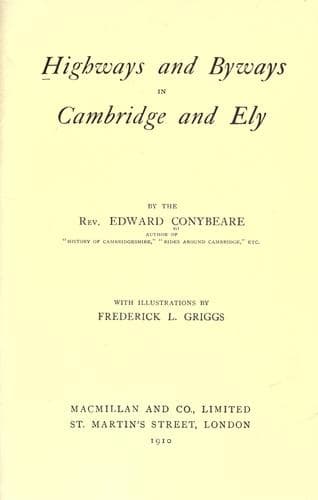
Highways and Byways in Cambridge and ElyConybeare, John William Edward
History
Highways and Byways in Cambridge and Ely
Conybeare, John William Edward
Cambridgeshire (England) -- Description and travel; Isle of Ely (England) -- Description and travel
This went on until Henry the Eighth fell upon the Church, and took
away not only many of the Episcopal demesnes but also many of the
Episcopal privileges (if indeed they may be so termed). Such rights as
the King spared survived for 300 years longer. The Bishop of Ely still
possessed a jurisdiction of considerable importance and dignity,
holding almost sovereign authority within his "Franchise," which was
styled "the Royal Franchise or Liberty of the Bishops of Ely." He
himself appointed his own Judges to hear all cases within the Isle of
Ely; Assize and Quarter Sessions were held in his name and at his
pleasure; his chief bailiff acted as High Sheriff, and he nominated
the magistrates. It was the Bishop's Peace, and not the King's Peace,
against which malefactors throughout the Isle were held to offend.
This went on till 1836, when on the death of Bishop Spark, these last
remnants of Etheldreda's jurisdiction as Queen-Abbess ceased by Act of
Parliament.
But to this day there live on some far-off echoes of the Girvian
principality. The Isle of Ely, with its three Rural Deaneries and
forty-six benefices, is ecclesiastically under the immediate
jurisdiction of the Bishop; no Archdeacon holds any authority there,
as in other parts of the diocese, except in the parishes of Haddenham
and Wilburton. True, we have an Archdeacon of Ely, but he ought
rather to be designated Archdeacon of Cambridgeshire, for, with the
exceptions named, beyond the limits of the county proper he is
powerless. The Isle, moreover, has its own County Council quite
distinct from that of Cambridgeshire, while the common High Sheriff of
both divisions is nominated from each in turn.
And in the very heart of London, close to Holborn Circus, traces of
this civil jurisdiction still survive in Ely Place, where stands,
abutting on houses of the most commonplace type, the beautiful chapel
dedicated to St. Etheldreda, built at the close of the thirteenth
century, and once attached to the town palace of the Bishops of Ely.
Ely Place was a "Liberty," and, within the memory of those still
living, the Royal writs did not run here, and no police-officer or
sheriff could follow a debtor who had here taken sanctuary; it was,
moreover, rated on a basis peculiar to itself. The "Liberty" is still
governed by certain Commissioners, elected annually by the
householders. It has its own day and night watchmen, with their
gold-laced hats, who fulfil the function of policemen, and the silence
of the night is, even in this twentieth century, broken by their call,
hour by hour, as of yore. We all remember how Shakespeare makes
Richard the Third say to the Bishop of Ely,
"My lord of Ely, when I was last in Holborn
I saw good strawberries in your garden there,"
Public-domain text, read in full here on John Shaqi.
Reviews
Reviews
No reviews yet
Be the first to share your thoughts on this work.
Elsewhere in the archive
Join the Discussion
Join the discussion
Sign in to leave a comment or review.
Sign InorCreate an account