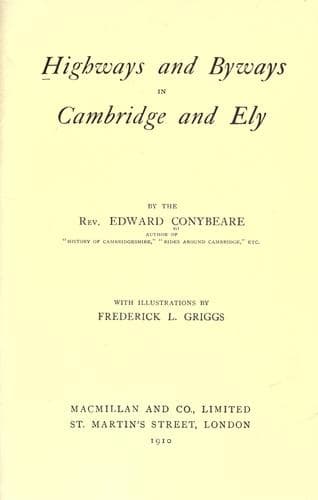
Highways and Byways in Cambridge and ElyConybeare, John William Edward
History
Highways and Byways in Cambridge and Ely
Conybeare, John William Edward
Cambridgeshire (England) -- Description and travel; Isle of Ely (England) -- Description and travel
"At the appointed time, accordingly, they met one night, and
began to dig, each separately by himself in the place assigned to
him. Thus it chanced that the aforesaid Brother John was digging,
all alone by himself, in the place allotted to him. And, by the
special will, as we verily believe, of God, he found there, not
one of his mates wotting thereof, a brazen pot full of money, as
if placed there on purpose to relieve his need.
"And when the whole night was well nigh spent, in the earliest
dawn, a small rain came on, to the annoyance of those digging.
Calling then his mates from their work, he said: 'Brethren mine,
and fellow labourers, yea, most heartily do I thank you for all
your long and well-wrought task. And good it is now to pause a
little after your work. Therefore I commend you to God. And may
He pay you a full worthy wage for your labour.' But when they
drew off, he himself remained on the spot all alone, and bare off
that urn, as secretly as he might, and hid it in the dormitory
under his own bed. And he took that money, all befouled with rust
as it was, and cleansed off the rust by rubbing it with chalk and
water, and paid therefrom, while it lasted, the wages of his
workmen."
From this account it would seem that this money was not gold, as that
never tarnishes, but silver; probably old Saxon coins hidden at the
time of the Danish sack of Ely. Even in the fourteenth century money
was still largely estimated by weight, without much regard to the
particular coinage; so that these old pennies would still be good
currency.
The chapel is surrounded by seats of stone, each with its canopy of
the same material, a veritable dream of artistic design and
workmanship. With its completion, at the close of the year 1348, John
of Wisbech ended his work on earth; a few months later, on June 18th,
1349, he, like many another priest of these eastern counties, fell a
victim to the Black Death, which in some districts slew nine priests
out of ten. He left as his monument this church, a wonderful example
of the latest Decorated work, in its detailed sculpture and all but
Perpendicular windows. It is built of clunch, a local stone that lasts
well for interior use, but perishes somewhat when exposed to the
weather. This was brought by water from Reach, where the great
quarries from which it was hewn may still be seen.
Public-domain text, read in full here on John Shaqi.
Reviews
Reviews
No reviews yet
Be the first to share your thoughts on this work.
Elsewhere in the archive
Join the Discussion
Join the discussion
Sign in to leave a comment or review.
Sign InorCreate an account