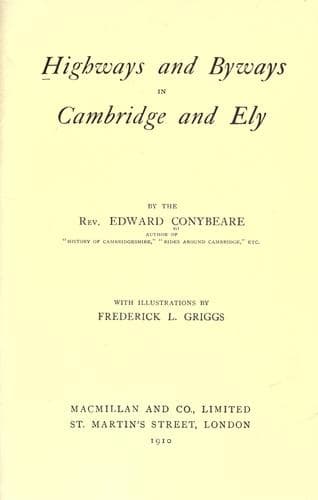
Highways and Byways in Cambridge and ElyConybeare, John William Edward
History
Highways and Byways in Cambridge and Ely
Conybeare, John William Edward
Cambridgeshire (England) -- Description and travel; Isle of Ely (England) -- Description and travel
This chapel was built, as its name denotes, in honour of the Virgin;
above and below its canopies stood figures of exquisite grace,
representing, for the most part, scenes from her life as related in
the Apocryphal Gospels and later legends then current. For two hundred
years these sculptures remained intact, till Thomas Goodrich became
Bishop in 1533. He held the See for twenty-one years, and he made it
his business deliberately to deface all this statuary. We may
attribute his action either to his zeal for the extirpation of
Mariolatry, or to his fear lest sacred legend should be confounded
with sacred history. Whatever may have been the actuating motive, his
deeds as an iconoclast remain before our eyes. In October, 1541, he
issued a mandate to the clergy of his diocese, ordering the utter
abolition and destruction of all shrines, images, and relics; and we
find it hard to forgive him for such indiscriminating breakage, even
when we remember how much we owe to him for his admirable setting
forth of our duty to God and to our neighbour preserved to us in the
Catechism of the Church of England. He was also the translator of St.
John's Gospel in the version known as the "Bishop's Bible."
[Illustration: _Ely Lantern._]
With the close of the fourteenth century the development and
beautifying of Ely Minster almost comes to a standstill. She is rich
in Norman, in Early English, in Decorated work; but when Perpendicular
architecture arose, that type peculiar to England, there came a pause
at Ely; and the instances of the Perpendicular style to be met with
here are comparatively unimportant insertions. In Bishop Alcock's
Chapel, built by 1500, we meet with late Perpendicular work; while in
Bishop West's, built about 1525, are traces of the Renaissance
decoration that came in with the revival of classical literature and
art. Such decoration gained hardly any foothold in England, and is
extremely rare within our shores, but on the Continent it swept away
before its inrush many a shrine of earlier date, sparing nothing for
the sake of its associations or antiquity. With Bishop West's Chapel,
the story of growth and development closes. Then came the
Reformation under Henry the Eighth, and we come face to face with the
work of iconoclasts rather than of builders.
Public-domain text, read in full here on John Shaqi.
Reviews
Reviews
No reviews yet
Be the first to share your thoughts on this work.
Elsewhere in the archive
Join the Discussion
Join the discussion
Sign in to leave a comment or review.
Sign InorCreate an account