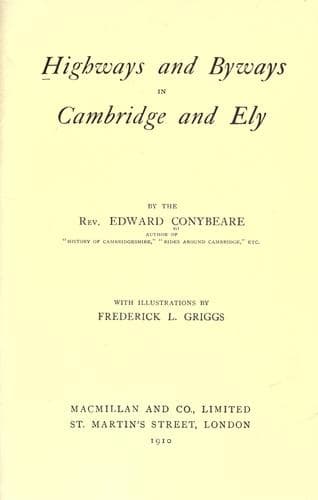
Highways and Byways in Cambridge and ElyConybeare, John William Edward
History
Highways and Byways in Cambridge and Ely
Conybeare, John William Edward
Cambridgeshire (England) -- Description and travel; Isle of Ely (England) -- Description and travel
At Ely one feature of beauty is lamentably absent, namely stained
glass contemporary with the building. In the Cathedrals of York and
Lincoln much ancient glass survives, while remnants exist in many
village churches; but at Ely, once no less richly be-jewelled, nearly
all has been swept away. There is no record of its destruction, which
may have taken place under the unsparing hand of Bishop Goodrich, or a
century later, it may be, during the Civil Wars. We are the losers,
and we can hardly feel that our loss is made good by the coloured
glass with which during the last hundred years many of the windows
have been refilled, though here and there fine modern glass sheds its
glow on the grey stonework around.
Yet as we walk round this glorious Minster, surveying it whether from
within or from without, the feeling uppermost in our minds is rather
one of thankfulness that so much has been spared than of indignation
that so much has been destroyed. We can understand what the
poet-philosopher Coleridge meant when he spoke of Gothic architecture
as "Infinity made imaginable"; and we may enter into the feelings of
the peasant woman who, in simpler language, expressed the same idea,
when after her visit to Ely Minster she remarked, "That Cathedral is
like a little Heaven below; everybody should see it, both rich and
poor."
We have now come to the end of the story of the building of Ely
Minster; her Bishops and Deans have since then had enough to do in
keeping her stonework in repair without adding to it; and this work of
restoration has been carried on from century to century with real, if
sometimes misguided, devotion. Originators have had their day; the
repairer is now in possession.
Great as were the architectural achievements of the seventy monks of
Ely, we must not suppose that all their time went in superintending
such work. We do not know, indeed, whether they did much of it with
their own hands at all. We have, it is true, seen John of Wisbech, the
builder of the glorious Lady Chapel, himself digging out the
foundations with his mates; but on the other hand we are told how
skilled artisans from a distance were hired to undertake the more
delicate work in completing the lantern. That the Brethren spent much
time in writing we have abundant proof. Our own familiar word _ink_ is
a standing testimony to their industry in this respect, being derived
from _inc._, the abbreviation universally used in the Abbey account
books for _incaustum_, the Latin word for their writing fluid.
In the reign of William Rufus, that monarch's Commissioners came to
Ely, and carried off 300 volumes from the Abbey library, besides all
the Service books; and we need hardly doubt that most of these books,
if not all, had been copied on the spot. One beautifully written
Breviary from Ely is still to be seen in the University Library at
Cambridge. It is of the fourteenth century.
Public-domain text, read in full here on John Shaqi.
Reviews
Reviews
No reviews yet
Be the first to share your thoughts on this work.
Elsewhere in the archive
Join the Discussion
Join the discussion
Sign in to leave a comment or review.
Sign InorCreate an account