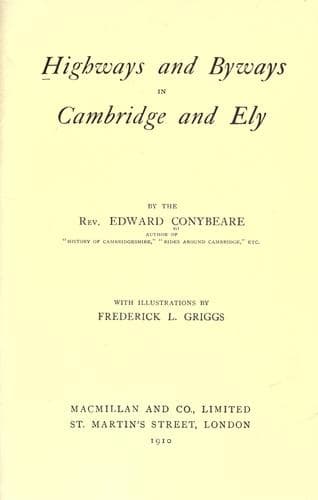
Highways and Byways in Cambridge and ElyConybeare, John William Edward
History
Highways and Byways in Cambridge and Ely
Conybeare, John William Edward
Cambridgeshire (England) -- Description and travel; Isle of Ely (England) -- Description and travel
The monks and Bishops were, moreover, constructors of bridges, of
roads, and of causeways; they made new ones, they restored the old;
and they were licensed to exact tolls for the upkeep of their work. In
1480 Bishop Morton led the way towards the draining of the Fens, by
cutting the great drain, forty feet across, extending twelve miles,
from Peterborough to Guyhirn, and still known as Morton's Leam. The
Bishops also built numerous episcopal residences. Among others, Ely
Place in Holborn, a castle at Wisbech, palaces at Somersham and
Downham, manor houses at Doddington, at Fen Ditton, at Hatfield, were
erected as the centuries slipped by; and seeing that the Bishops were
also Abbots of Ely, we may believe that the monks did their part in
carrying out episcopal work.
Ely possesses a unique record of her early days in her celebrated
Liber Eliensis, a folio volume of 189 leaves of vellum, ten and
a-half inches by seven and a-half, begun by Thomas, a monk of the
convent, who lived about the close of the twelfth century, and
professing to give the history of the monastery from its foundation up
to his own day. Two copies of this manuscript are known to exist,
bearing witness to the industry of the monks as scribes, while others
have doubtless perished. The monks of Ely, moreover, wrote the
Episcopal Rolls and Registers with the utmost care; these are still
preserved with their entries as to the expenditure of money, as to
ordinations, as to the granting of indulgences, as to appeals to the
Pope, all kept with scrupulous exactitude.
Ely is rich, moreover, beyond most foundations, in other written
records of her past; and these are preserved, some in the Cathedral
library, some in the muniment room of the dean and chapter forming
part of the restored "Steeple" or "Sextry" gateway, some in the
library of Lambeth Palace, some in the British Museum. The existing
rolls, or account books, kept by the chief officers of the monastery,
number 288 in all, and give us full and clear detail as to what was
spent not only on the building, the alms, and the services of the
Abbey Church, but also on the food, the wine, the clothing, and the
medicine of the monks. One item of medicine is "dragon's blood," one
of food is "blankmang, a mixture of rice and almonds."
The following summary from the Chamberlain's Roll, recounting what was
the cost of clothing a monk, will show us that he was expected to
dress with dignity and comfort. The clothing of an Ely monk was really
a very serious item of expenditure. A monk, like the parson of a
church, was in England _ex officio_ a gentleman; and his maintenance
cost his convent the equivalent of L200 per annum (in the present
value of money).[214] Of this sum at least a fourth went in clothing,
which, as compared with food, was much dearer then than now. The
account books still preserved at Ely give us the items. Each monk
received annually the following garments (for which we give the value
at the present rate of money):
Public-domain text, read in full here on John Shaqi.
Reviews
Reviews
No reviews yet
Be the first to share your thoughts on this work.
Elsewhere in the archive
Join the Discussion
Join the discussion
Sign in to leave a comment or review.
Sign InorCreate an account