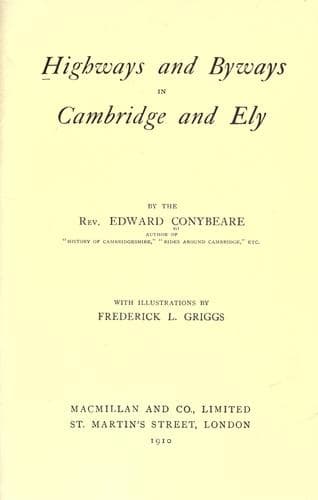
Highways and Byways in Cambridge and ElyConybeare, John William Edward
History
Highways and Byways in Cambridge and Ely
Conybeare, John William Edward
Cambridgeshire (England) -- Description and travel; Isle of Ely (England) -- Description and travel
Retracing our steps, we have on our right ancient buildings at present
used by the boys of the same school; beyond them we reach again the
Ely Porta; and this time we pass through it to find ourselves in a
side street of the little city, along which run the station omnibuses.
Opposite the gateway is a modern building, "Hereward Hall," occupied
by the King's Scholars; while the dignified Chamber of the Ely Porta
is also at their service in school hours. Turning to the right we
follow the street, here styled "the Gallery," and we make straight for
the cathedral. On our left is the wall of the Palace garden, and,
showing well above, we see its splendid plane tree, planted in 1639,
and said to be the finest in England.
Now we are actually approaching the western tower and the
south-western transept of the cathedral; and these we may take as an
object lesson. Ely, like Rome, was not built in a day, and it took
centuries to complete its tower. Begun during the latter half of the
twelfth century, the lower part is of late Norman work, with round
arches and bold simple mouldings; but the architect and workmen who
built these passed away, and their work had to be continued by the
hands of others on whom had dawned the beauty of pointed arches. These
later builders were not to be tied down by what they felt to be the
crude ideas of former generations; and we see the workmanship of the
tower and transept, stage above stage bearing evidence of growth, till
through the Early English period it has passed into a narrowed
octagonal tower with windows of Decorated tracery. There is a
delicious harmony in it all; in the intricacy of the masonry, in the
very colour of the stone; and we admire those builders of yore who,
while respecting the work of their forefathers, did not hesitate to
deal with their material according to their own fuller light and
skill. Perhaps we shall doubt as to calling the topmost octagonal
tower wholly in keeping with the base of the steeple; yet if we had
the power we should not have the wish to alter it.
It is well that we should realise how much the preservation of this
stately steeple has cost. Ever since the central tower fell in 1322,
sacrists, priors, monks, bishops, deans, have lived in constant terror
lest what had befallen the central might also befall the western
tower. We can read how they have braced it with iron and wood, how
they have weighted it with bells; how they have lightened it by
removing its wooden spire, how they have buttressed it, how they have
plastered it. Century after century they have continued the repairs,
sometimes making mistakes, but never asking the question, fatal to all
good work, "Is it worth while?" There it stands, surveying its vast
plain for thirty miles around, with its air of unbroken security.
Public-domain text, read in full here on John Shaqi.
Reviews
Reviews
No reviews yet
Be the first to share your thoughts on this work.
Elsewhere in the archive
Join the Discussion
Join the discussion
Sign in to leave a comment or review.
Sign InorCreate an account