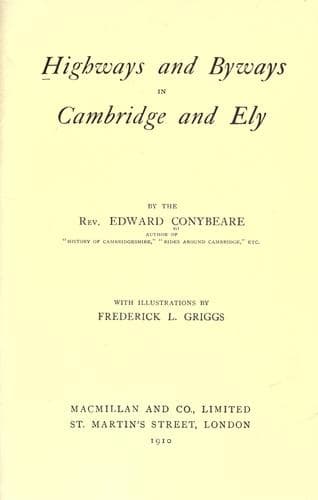
Highways and Byways in Cambridge and ElyConybeare, John William Edward
History
Highways and Byways in Cambridge and Ely
Conybeare, John William Edward
Cambridgeshire (England) -- Description and travel; Isle of Ely (England) -- Description and travel
Jutting out from the tower, westward, is the so-called Galilee Porch.
It is conjectured that it was so named because, as Galilee was the
district of the Holy Land furthest from Jerusalem, so this western
porch was the part of the sacred building farthest from the High
Altar. Much doubt exists as to the date of this porch. It is commonly
said to have been built under Bishop Eustace, who died in 1215; but
some authorities hold that it belongs to a somewhat later period, when
the style in which it is built had fully developed. Probably it dates
from the close of his episcopate. Anyhow, it is a beautiful specimen
of that Early English work of which we shall see so much more before
we leave the Cathedral. Its walls are thicker than needful if the
porch alone were to be considered, and it is thought that it was built
thus massively with a view to acting as a buttress to the tower, which
needed support. Over the porch is a parvise chamber, now disused; it
may in early days have served to accommodate musicians, or as a place
of sanctuary for criminals fleeing from justice. During the eighteenth
century the Galilee narrowly escaped demolition; for Essex, who was
architect to the Chapter of Ely, advised that it should be pulled down
as being of no use, and in a condition too ruinous to admit of repair.
Happily his counsel was rejected, and the Galilee still stands to
gladden our eyes with its beauty.
From the Galilee we step into the nave. To attempt any description of
the view before us would be futile; when we say that we are "uplifted"
by it we have expressed in one word all that we dare to formulate. By
moonlight, when the minster is empty; or on some day of Choral
Festival, when arch and pillar echo back the music, this wondrous
fabric, hallowed and mellowed by time, says to us, with a voice almost
audible, "Sursum corda!" "The place whereon thou standest is holy
ground."
The nave in which we are standing is wholly Norman in its
architecture; its pillars, alternately clustered and cylindrical,
support round arches; these again support the round-headed double
arches of the triforium, and these yet again the triple lights of the
clerestory windows, three tiers in all. The arches are somewhat
stilted, starting with a straight line, and are rather higher than
semi-circular. All this severe architecture of Norman type leads on,
as it were, to the more delicate tracery and moulding of the Early
English lancet lights of the east window.
Public-domain text, read in full here on John Shaqi.
Reviews
Reviews
No reviews yet
Be the first to share your thoughts on this work.
Elsewhere in the archive
Join the Discussion
Join the discussion
Sign in to leave a comment or review.
Sign InorCreate an account