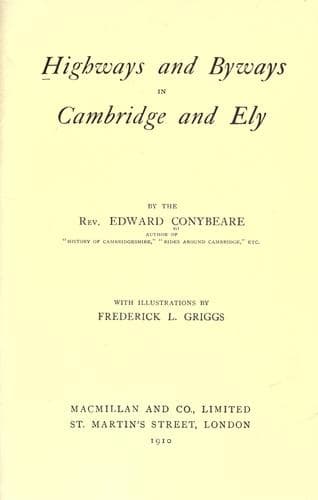
Highways and Byways in Cambridge and ElyConybeare, John William Edward
History
Highways and Byways in Cambridge and Ely
Conybeare, John William Edward
Cambridgeshire (England) -- Description and travel; Isle of Ely (England) -- Description and travel
[Footnote 225: This was the average length in the larger abbeys,
notably surpassed only by the splendid dimensions of Glastonbury,
where the cloisters were a square of 221 feet on each side.]
We shiver at the very thought of the cold that life in the cloister
must have entailed. We hear of a scribe whose hands were so paralysed
by cold that he had to delay finishing his copy of the works of Bede;
one author had to lay aside his writing for the winter till spring
should return. No attempt was made to heat the cloisters, but in
mid-winter a single fire was kept burning in a room called the
"_calefactorium_" where the brethren might go in turn to warm
themselves. We speak of life in the open air as an idea of modern
days; in truth it had been forestalled by the monks of old. The
cloisters were lighted by lamps fed with grease from the kitchen, and
the candles used were of rush-pith dipped in the same.
Silence was maintained in the cloister, and the monks used signs
instead of words when asking for a book. Strict rules were laid down
as to the keeping clean and putting back of books. One Benedictine
writer adds to his manuscript the following note: "Whoever pursues his
studies in this book should be careful to handle the leaves gently and
delicately, so as to avoid tearing them; and let him imitate the
example of Jesus Christ who, when he had quietly opened the book of
Isaiah and read therein attentively, closed it with reverence and gave
it again to the minister." The lending of books was counted as one of
the principal works of mercy, but only to be done under the most
careful regulations as to the return of the volume lent. Such is in
outline the scene we should have beheld had it been our lot five
hundred years ago on this very ground,
"To walk the studious Cloister's pale."
We now re-enter the cathedral through the Prior's Door, and taking a
few steps further along the interior of the aisle we come to Owen's
Cross. Owen was St. Etheldreda's faithful steward, the "Primus
Ministorum" (or "Over-alderman," as the Anglo-Saxon has it,) of her
fenland kingdom, and governor of her family. His Welsh sounding name
bears witness to his being a fenman of British ancestry. Bede tells us
that Owen was a man of much piety; that when his royal mistress no
longer needed his services he forsook the world and became a monk
under St. Chad, Bishop of Lichfield. Owen set forth on his journey to
the monastery dressed in a plain garment, carrying a pick-axe and
bill-hook, to denote that as he was little capable of meditating on
the holy scriptures he would the more earnestly apply himself to the
labour of his hands, and had not come to the monastery, "as so many
do," to live idle. St. Chad received him with much favour, and it was
Owen who was permitted to hear the angelic voices that announced to
the holy bishop that he was to die within seven days.
Public-domain text, read in full here on John Shaqi.
Reviews
Reviews
No reviews yet
Be the first to share your thoughts on this work.
Elsewhere in the archive
Join the Discussion
Join the discussion
Sign in to leave a comment or review.
Sign InorCreate an account