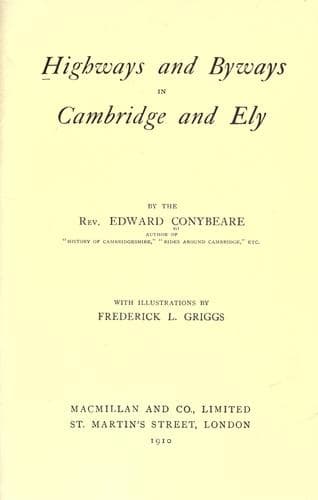
Highways and Byways in Cambridge and ElyConybeare, John William Edward
History
Highways and Byways in Cambridge and Ely
Conybeare, John William Edward
Cambridgeshire (England) -- Description and travel; Isle of Ely (England) -- Description and travel
Owen was himself canonized, and this cross became an object of
veneration at Haddenham, where pilgrims from Cambridge crossed the
Ouse. During the eighteenth century its mutilated base was brought
into the cathedral from Haddenham, where it had long served as a
horsing-block. It is now more worthily placed, and we can still read
the inscription in Latin which runs as follows (the name of Owen being
Latinized almost out of recognition),
LUCEM TUAM OVINO
DA DEUS ET REQUIEM.
AMEN.
Grant O God to Owen Thy light and rest. Amen.
A little further on, still in the south aisle, we come to the "Monks'
Door," with its strange outer carvings of dragons, its one door-post
enriched with spiral fluting, a sister doorway to the prior's, but by
no means a twin. Almost touching it is the half of an ancient arched
doorway now walled up, its door-post spirally and deeply sculptured.
In both doorways one door-post is hidden by the masonry of a great
buttress built here by Alan of Walsingham to support his central
tower. We are here in the last remnant of Ely's cloisters, and let us
not fail to observe the recessed archway for books in the southern
wall of the nave mentioned above. Before leaving the aisle we should
notice that its windows are for the most part late insertions, the
original Norman fenestration being replaced by Perpendicular.
We now come to the wonder of Ely, of which we have already heard much,
its Octagon Tower and Lantern. Other features in the cathedral we may
meet with elsewhere, but this central feature was not itself a copy,
nor has it served as a pattern--it remains alone, a brilliant
make-shift, a great Necessity having proved the mother of a great
Invention. We can hardly here enter into the details of this Octagon
Tower as an engineering feat, but we can remind our readers how, by
enlarging the base of his steeple, by making it rest on eight
supporting piers, instead of on four like its fallen predecessor,
Alan of Walsingham gave it greatly increased stability.
[Illustration: _The Tower from the Cloisters._]
Thomas Fuller, whom we have quoted before, thus racily describes the
Lantern at Ely, as it was at the close of the Commonwealth, and draws
from it the lesson he loved to find underlying outward things. After
speaking of the beauty of the minster, he goes on to say, "The
lanthorn therein, built by Bishop Hotham, is a masterpiece of
architecture. When the bells ring the woodwork thereof shaketh and
gapeth (no defect but perfection of structure) and exactly chocketh
into the joints again; so that it may pass for the lively emblem of
the sincere Christian who, though he has _motum trepidationis_ of fear
and trembling, stands firmly fixed on the basis of a true faith."
Public-domain text, read in full here on John Shaqi.
Reviews
Reviews
No reviews yet
Be the first to share your thoughts on this work.
Elsewhere in the archive
Join the Discussion
Join the discussion
Sign in to leave a comment or review.
Sign InorCreate an account