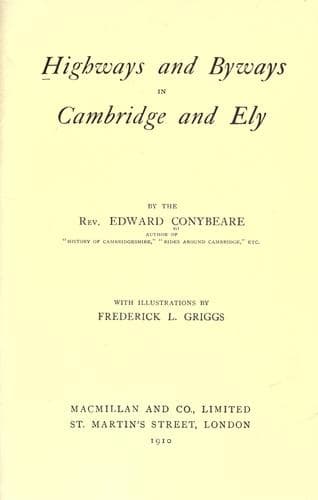
Highways and Byways in Cambridge and ElyConybeare, John William Edward
History
Highways and Byways in Cambridge and Ely
Conybeare, John William Edward
Cambridgeshire (England) -- Description and travel; Isle of Ely (England) -- Description and travel
From the Octagon we can view the transepts begun in 1083 by Abbot
Simeon. The columns and mouldings bear witness to the fact that these
eastern transepts are of earlier date than the nave. At the western
corner of the north transept we notice a doorway of classical design
inserted in 1699 by Sir Christopher Wren, to repair a fall which had
taken place there. Before leaving this transept let us enter the
Chapel of St. Edmund (one of two screened off chambers against the
eastern wall), and take note of the alabaster reredos, exquisite in
design and material, placed there in 1898 by Canon Stanton, in memory
of his father.
[Illustration: _Cathedral Towers._]
On this reredos Christ appears in glory, as the ascended High Priest
of His Church, interceding for His people. Beneath on the retable is
inscribed in Greek the words: "Able to save them to the uttermost that
come unto God by Him." The chapel is intended to be used for private
meditation and for services connected with missionary work. We leave
it with the sense that the highest message the minster has to give is
still remembered among us.
From the Octagon we may pass into the Choir, where gates of brass open
through the richly carved screen of oak. This screen is a really
beautiful creation of the nineteenth century, while the tabernacled
oaken stalls within are mediaeval, dating from 1337, and are yet more
beautiful, forming as they do part of Alan of Walsingham's great
restoration. For over four centuries these stalls stood where Alan
placed them, under the Octagon, separated from the nave by a massive
Norman screen of stone. About 1770 they were moved by the architect
Essex to the eastern end of the Choir. The stalls having been thus
removed, Essex saw no reason for preserving the Norman screen, so he
had it destroyed. Had the venerable structure still stretched across
the nave we should feel it purposeless, and it would undoubtedly have
been inconvenient: so we ought perhaps to admit that Essex really
conferred on the cathedral a boon by his drastic act on which a less
daring and more conservative architect would not have ventured. Still
we send a sigh of regret after the ancient work, that had stood
through so many centuries only to be pulled down as an encumbrance,
and carted away at last as rubbish.
Public-domain text, read in full here on John Shaqi.
Reviews
Reviews
No reviews yet
Be the first to share your thoughts on this work.
Elsewhere in the archive
Join the Discussion
Join the discussion
Sign in to leave a comment or review.
Sign InorCreate an account