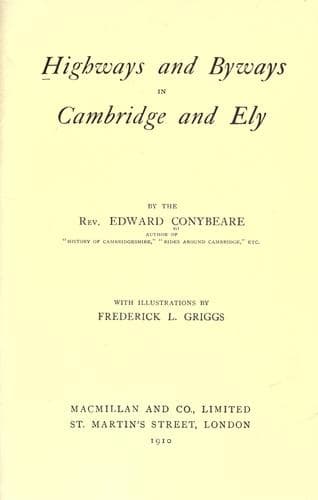
Highways and Byways in Cambridge and ElyConybeare, John William Edward
History
Highways and Byways in Cambridge and Ely
Conybeare, John William Edward
Cambridgeshire (England) -- Description and travel; Isle of Ely (England) -- Description and travel
The stalls after their removal eastward were painted to look like
mahogany (!) in accordance with eighteenth century standards of beauty.
They were left in this far eastern position for about eighty years, when
they were shifted half-way back again, into their present place, under
the supervision of Sir Gilbert Scott, the architect employed to direct
the restoration then in progress. Their upper panels have been filled
with Bible scenes carved in high relief in wood; mostly the work of a
Flemish artist of the nineteenth century. On the south are scenes from
the Old Testament, on the north from the Gospels. They repay a careful
study, being beautiful and original in design. Twenty-five in number on
either side, arranged chronologically, they face each other, answering
in several instances as type and antitype; the Deluge corresponds with
the Baptism, Jacob's Deception of Isaac with the Betrayal; the Lifting
up of the Brazen Serpent with the Crucifixion, the Ascent of Elijah with
the Ascension. Whether this is intentional or accidental we leave to be
decided by those who, familiar with Bible incidents, are wishful to
exercise their ingenuity and their power of discernment, in discovering
further and less obvious correspondence.
The stall seats are on hinges, and are known as "Miserere" (_i.e._
mercy) seats. They were thus named from being so contrived that when
turned back they gave a merciful support to the monks, who could thus
sit after a fashion, instead of having to stand, during the lengthy
nocturnal services in which they were engaged; but if the occupant of
the stall abused this relief by permitting himself to be overcome with
sleep, he and his seat fell forward together with a crash, to his
great discomfiture. When turned back the quaint carvings usual under
such seats may be seen, the work of the fourteenth century carvers.
The subjects represented are strangely varied; scriptural, legendary,
grotesque, according to the taste and fancy of the carver, and no two
are alike. We find here Noah's Ark, a pelican feeding her young, a nun
at prayer, monkeys and dragons, a woman beating a fox for robbing her
hen-roost, a fox attired as a bishop, a monkey extracting a man's
tooth, a king and a monk fighting, St. Martin sharing his coat with a
beggar. The upper canopied work of these stalls is of delicate beauty,
little damaged by all it has undergone, whether of neglect or of
change, during the six centuries and a half of its existence.
But while admiring these choir stalls, we are almost inclined to
grudge their presence, for they obstruct the view of the stone arches
against which they stand. We are still beholding the work of the great
Alan; after the tower fell he and his workmen built these three bays,
with the triforium and clerestory arches above; and we feel how
perfectly brain, heart, and hand must have worked together in harmony
to produce so exquisite a result. It was Bishop Hotham who provided
the funds for most of this work.
Public-domain text, read in full here on John Shaqi.
Reviews
Reviews
No reviews yet
Be the first to share your thoughts on this work.
Elsewhere in the archive
Join the Discussion
Join the discussion
Sign in to leave a comment or review.
Sign InorCreate an account