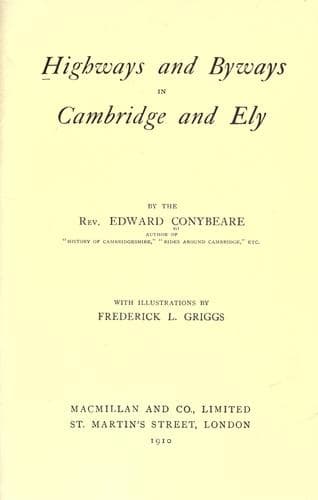
Highways and Byways in Cambridge and ElyConybeare, John William Edward
History
Highways and Byways in Cambridge and Ely
Conybeare, John William Edward
Cambridgeshire (England) -- Description and travel; Isle of Ely (England) -- Description and travel
We will next look at the impressive monument of William of Kilkenny,
Bishop of Ely for three years under Henry the Third. He gave great
offence through being consecrated bishop by the Archbishop of
Canterbury in Italy, instead of in England, where it was felt that
both prelates ought to have been attending to their duties at home;
he, moreover, died abroad on a journey to Spain, whither he was going
on the King's business. A traveller and statesman, he was also a
generous promoter of education, as is shown by his founding
scholarships at Barnwell Priory. A recumbent figure holding a crozier,
he rests on a pillow as if asleep.
Next we reach the tomb of Bishop Redman, who held the See for a very
short time in the opening years of the sixteenth century. The tomb is
of fine Perpendicular work, and the Bishop lies under a canopy rich in
armorial bearings; but the figure is strangely truncated at the foot,
which derogates not a little from its beauty.
Retracing our steps for a few yards, we find beneath our feet a brass
which records one of the tragedies that the Minster has witnessed;
here lies buried Basevi, the gifted architect of the Fitzwilliam
Museum at Cambridge, who met with his death in 1845 while accompanying
Dean Peacock over the work of repair going on in the western tower.
The Dean had just a moment before given the architect a caution to
take care how he walked. Basevi, familiar with scaffolding, smiled at
the advice, and going on with his hands in his pockets, came to a hole
he had not perceived, and fell through in a way that would have been
well-nigh impossible had his hands been free; his feet struck the
pavement below with a jar so intense that death was almost
instantaneous.
And now we end our tour round these sepulchres and monuments by
contemplating all that remains of what was once the rallying centre
for those countless pilgrims who travelled hither in search of
spiritual and physical benefit--the shrine of St. Etheldreda. It was
once enriched with gems and costly hangings. It has been told how
Queen Emma, in 1016, gave it a "purple cloth worked with gold and set
with jewels."[228] Sixty years later the shrine is described as "made
in part of silver, as adorned with pearls, emeralds, onyxes,
alamandine stones, embossed with images in relief, among which were
two lions carved in crystal, also four figures of angels carved in
ivory." Such it was made by Theodwin, who was Abbot for three years
under William the Conqueror, and such he left it. After another sixty
years it was robbed by Bishop Nigel, who took away much of its gold
and silver and used it for his own purposes.
[Footnote 228: See p. 314.]
Public-domain text, read in full here on John Shaqi.
Reviews
Reviews
No reviews yet
Be the first to share your thoughts on this work.
Elsewhere in the archive
Join the Discussion
Join the discussion
Sign in to leave a comment or review.
Sign InorCreate an account