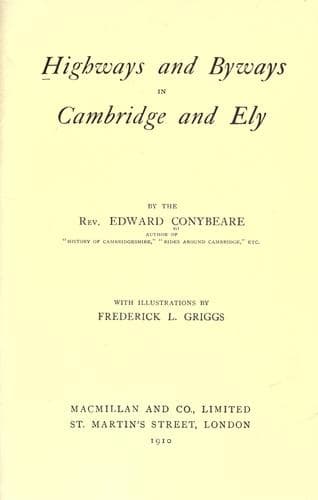
Highways and Byways in Cambridge and ElyConybeare, John William Edward
History
Highways and Byways in Cambridge and Ely
Conybeare, John William Edward
Cambridgeshire (England) -- Description and travel; Isle of Ely (England) -- Description and travel
But if it was despoiled in one century it was enriched in the next.
From 1252 it stood behind the High Altar in Bishop Northwold's
Presbytery, erected purposely for its reception; with the figure of
the Foundress of the Abbey gazing down upon it from the central boss
of the vaulting overhead. The shrine was thus held in honour till the
reign of Henry the Eighth; when the Royal greed swooped down upon it,
the dust of Etheldreda was thrown we know not where (though the chapel
in Holborn bearing her name, and the church of the Dominicans at Stone
in Staffordshire claim to possess relics of her hand), her coffin was
broken up and destroyed, the treasures that adorned her shrine were
dispersed. Love of loot was the great motive for this spoliation;
hatred of abuses, some real, some imaginary, was the hypocritical
excuse. Whatever may have been the pretext for its demolition, the
shrine was robbed and left empty.
The existing monument is a vaulted canopy of the fourteenth century,
and is held to be due to Alan of Walsingham. Much of the ancient
colouring survives on its northern side, but the southern has been
completely refaced with new stone-work. Let no one leave without
stooping down to pass beneath it, where it is easy to stand upright.
It was here that pilgrims congregated, happy in the sense that they
were in close proximity to the bones of the sainted Abbess. Here once
was sheltered the sarcophagus of marble that held the body of the
Foundress of the Abbey. Sturdy blows must have been needed to
annihilate it; but destroyed it was, and no tradition gives any record
of its fate, nor has any remnant of it ever been recovered. Stripped
as we see the shrine, now set aside in the northern aisle of the
presbytery, it seems left to prove that dignity may linger on for
ages, long after the word has been spoken "Thy glory is departed."
Before leaving the cathedral we must pass into the Lady Chapel
adjoining the north-eastern transept, connected with it by a passage.
We have already told when and by whom it was built, and when and by
whom it was desecrated. At the Reformation it was rededicated to the
Holy Trinity, and became a parish church, replacing the church of St.
Cross, which once stood close to the cathedral, but was pulled down
during the sixteenth century. Our visit must have its painful side, as
we remember how one form of faith built this chapel and another
defaced it. We could envy those who saw it fresh from the hand of
gifted sculptors and masons, its windows, now so bare, all aglow with
colour of a richness to which the few poor fragments that remain bear
eloquent testimony.
Public-domain text, read in full here on John Shaqi.
Reviews
Reviews
No reviews yet
Be the first to share your thoughts on this work.
Elsewhere in the archive
Join the Discussion
Join the discussion
Sign in to leave a comment or review.
Sign InorCreate an account