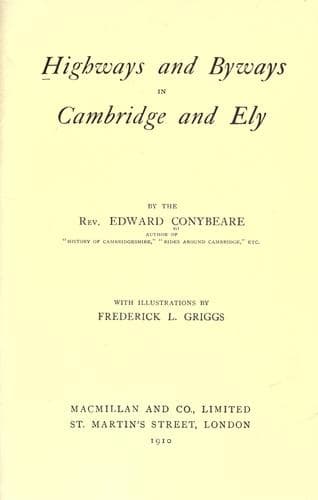
Highways and Byways in Cambridge and ElyConybeare, John William Edward
History
Highways and Byways in Cambridge and Ely
Conybeare, John William Edward
Cambridgeshire (England) -- Description and travel; Isle of Ely (England) -- Description and travel
Those who wish to be acquainted with the structural secrets of the
cathedral should make an effort to gain admittance to one of the
spiral staircases to the upper passages that lead from triforium to
triforium, from clerestory to clerestory. In these higher regions we
shall still come upon deeply wrought crocketing, such as that in the
upper eastern lancet windows--crocketing seen only by the stray
visitor, yet worked with ungrudged labour and skill. Here we may step
along the plank that takes us from beam to beam for a hundred feet
over the vaulting of the Choir, through the spacious chamber that
separates this vaulting from the outer roof. On every beam stands a
pail of water ready in case of fire.
Through a low doorway at the end we pass to the circle of the lantern.
Here a shutter-like panel can be opened and we can look downwards if
we will, but we shall probably elect rather to spend these rare
minutes in gazing upwards, on the figure of Christ in the key boss of
the vaulting, now that for once in our lives we find ourselves near
enough to John of Burwell's carving to see how bold and yet how
reverent it is.[229]
[Footnote 229: See p. 358.]
One question forces itself upon us, how was it placed here? How was
Mr. Gambier Parry able to paint the glowing angels on these panels? We
see in imagination the scaffolding, the ropes, the pulleys, that have
been in use here, where now all is calm and rest, and we feel that
William Watson might have had this very scene before him when he wrote
the lines:
"No record Art keeps
Of her travails and woes:
There is toil on the steeps,
On the summit repose."
The tourist has one further duty to perform; for he must not leave Ely
without walking round the cathedral outside. He will then be perplexed
by the anachronisms before him; he will see Perpendicular windows
inserted in Norman aisles, Decorated tracery in Early English masonry;
he will observe this from without more plainly than from within, and
he will realise how the monks who designed and built it all had a firm
belief in themselves, and in their own age, so that they did not
shrink from what we should now count as acts of Vandalism. They no
more hesitated to displace the work of their forefathers by their own,
than we hesitate to light our houses and churches with electricity,
instead of being content with the gas that was good enough for our
grandparents.
Public-domain text, read in full here on John Shaqi.
Reviews
Reviews
No reviews yet
Be the first to share your thoughts on this work.
Elsewhere in the archive
Join the Discussion
Join the discussion
Sign in to leave a comment or review.
Sign InorCreate an account