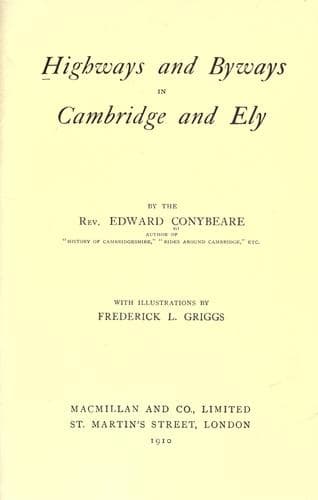
Highways and Byways in Cambridge and ElyConybeare, John William Edward
History
Highways and Byways in Cambridge and Ely
Conybeare, John William Edward
Cambridgeshire (England) -- Description and travel; Isle of Ely (England) -- Description and travel
As we turn to the north, on leaving the cathedral by the western door,
we shall be puzzled by the strange appearance of the steeple on its
northern side. For Ely Minster, we cannot deny it, is lop-sided; it
has no north-western transept to correspond with the south-western. On
the north side of the tower there is masonry proving that once it had
the support of such a transept; but there is no record of its fall or
demolition, so we are left to surmise that perchance it shared the
fate of the adjoining church of St. Cross, described as a "lean-to,"
dark and "uncomley, very unholdsome for want of thorrowe ayre" which
we know to have been pulled down during the reign of Elizabeth.
We must now go eastward, and, keeping close to the cathedral as we
follow the path that surrounds it, we shall be able to drink in the
view, described earlier, of the Minster as seen from the east. From
this point we can grasp it all, and we can feel ourselves in close
touch with the builders of yore, with Simeon, and Richard, and Hugh,
and Alan, and John; for the work of each is here before our eyes at
once. They now rest from their labours, leaving them as a priceless
legacy to benefit ourselves and others. Look at Richard's transepts
resting on old Simeon's foundations; look at Hugh's lancet windows, at
Alan's incomparable lantern, at the Lady Chapel which John was able to
build through his finding of that brazen urn. The space that lies
between us and these men of mark seems bridged by a span as we
contemplate their work and try to understand it.
As we complete our circuit of the East end, and stand at that of the
south transept, we shall be struck with a conspicuous range of ruined
arches built into the Canons' residences to the south-east. These are
the remains of the Infirmary; which we have seen to play such an
important part in the life of the Abbey. It had its own chapel, hall
and kitchen, and stood on the site of the original Saxon church. The
space between it and the Minster was called the Slype, and served as a
kind of market, whither travelling merchants brought their wares for
the inspection of the Prior, Sacrist, and other chief officers of the
Abbey. These officers, we may mention, did not share the common life
of the monks, but had houses of their own, fragments of which still
dot the "College,"--mostly, like the Infirmary, now built into the
residences of the various Canons.
Public-domain text, read in full here on John Shaqi.
Reviews
Reviews
No reviews yet
Be the first to share your thoughts on this work.
Elsewhere in the archive
Join the Discussion
Join the discussion
Sign in to leave a comment or review.
Sign InorCreate an account