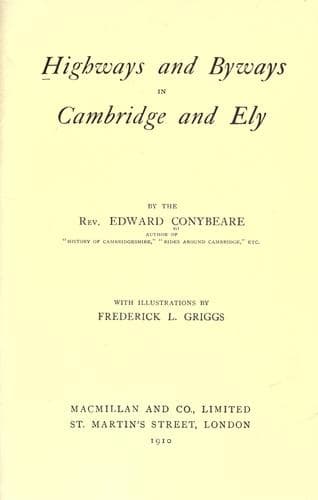
Highways and Byways in Cambridge and ElyConybeare, John William Edward
History
Highways and Byways in Cambridge and Ely
Conybeare, John William Edward
Cambridgeshire (England) -- Description and travel; Isle of Ely (England) -- Description and travel
[_The . duty . toward . god . is . to .
believe . in . him . to . love . him .
with . all . our . hert . & . soul .
and_] . all . our . power . to . wors
hippe . god . to . give . him . tha
nkes . to . put . our . whole . trust
in . him . and . to . cal . on . him . to
honoure . his . holy . name [_and
his_] . worde . and . to . serve . god
[_truly_] . all . the . days . of . our
lyfe.
The duty towards our neighbour, on the western side, is in Old English
letters, in fourteen lines, as follows:--
The . duety . [_towards . our . neigh_]boure . is
to . love . him . a[_s . we . do . ourself . an_]d . to
do . to . all . men . as . I . wo[_uld . they . do ._ ]to . me
to . honour . and . obay . [_the . King . and . all . set_] under . him ? ? ?
beme ? ? [_and . to . order . ourselves_]
lowly . to . all . [_our . betters_] . to . hurt . no
body . by . word . nor . d[_eed . to . be . jus_]te . in . all
our . delyng . to . bear . no . [_malice_] . in . our . hert
to . kep . our . handes . from . stelyng . & . our
tong . from . evil . speaking . to . kep . our . bo
dys . in . temperance . not . to . covet . other . mens .
goods . but . laboure . truly . for . our . lyvyng . in . y^e
state . of . lyfe . it . plese . God . to . call . us . on . to .
Of the many residences once belonging to the See, this palace is all
that is left. In looking back, we must remember that in days when
travelling was difficult it may have been of real advantage to the
Bishop to have places of abode dotted all over his diocese, where he
could stay, and where he could exercise his episcopal functions. We
read, for instance, how, in 1487 and the following year, Bishop Alcock
admitted between forty and fifty persons to minor or higher orders in
his chapel at Downham Manor.
[Illustration: _St. Mary's Church._]
Beyond the Palace stands St. Mary's Church, built by Bishop Eustace
about 1200, while Norman architecture was developing into Early
English. It has been remarked that "its architect was disposed to
adopt the new style without quitting the old one." The columns of the
nave are simple Norman; the chancel and chapel on the south are
distinctly Early English; the tower and spire are of Decorated work;
and we meet with inserted Perpendicular windows. In the midst of a
well-kept churchyard may be seen a broken and ancient font, with an
inscription embossed in lead stating that it has been so placed that
it may receive only the water of heaven.
Public-domain text, read in full here on John Shaqi.
Reviews
Reviews
No reviews yet
Be the first to share your thoughts on this work.
Elsewhere in the archive
Join the Discussion
Join the discussion
Sign in to leave a comment or review.
Sign InorCreate an account