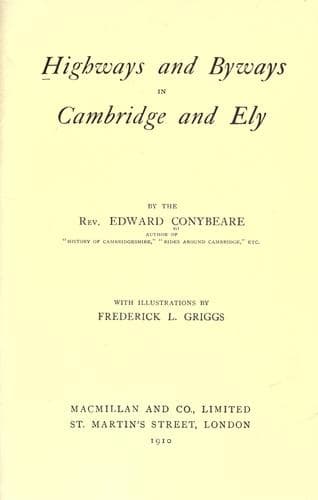
Highways and Byways in Cambridge and ElyConybeare, John William Edward
History
Highways and Byways in Cambridge and Ely
Conybeare, John William Edward
Cambridgeshire (England) -- Description and travel; Isle of Ely (England) -- Description and travel
The citizens of Ely throughout the Middle Ages were well provided with
churches, having for their devotions both St. Mary's and also St.
Cross, of which we have spoken before. The name St. Cross has an
interesting history. When first the abbey was built, there stood
against the stone rood-screen thrown across the nave an altar known as
the Altar of the Holy Cross; here the inhabitants of the city were
invited to worship, while the monks said their office quite apart
within the screen. But, as time went on, the monks found that this
twofold worship was not convenient, and, wishing to have the Abbey to
themselves, they built, immediately outside it on the north, a church
for their lay neighbours, "for doing such things as should be done in
a parish church," and named it St. Cross, after the altar within the
Minster which was thus superseded. With the dispersion of the monks
the nave came again into public use, and the church of St. Cross was
permitted to decay, and was finally removed.
Adjoining the churchyard of St. Mary's stands the vicarage. It is a
rambling house of moderate size, quaintly made of rough hewn beams
with reed-stiffened clay in between, and opening on to the street.
This house has a notable history. It was first built as a tithe house,
and was within the same ring-fence as the great barn or granary for
the storing of the tithe sheaves belonging to the monastery. In this
house lived the farmer of the tithes, who bore the title of Steward,
and collected tithe, first for the monks, later for the Dean and
Chapter of Ely; and as this office became hereditary the name of
Steward was taken as a family surname. The last of these Stewards was
Sir Thomas, who died in 1636, leaving no son to succeed him; but his
daughter Elizabeth was the mother of Oliver Cromwell, and Oliver by a
very natural arrangement stepped into his grandfather's office. He
accordingly left his home at St. Ives, sixteen miles distant, bringing
his wife, his mother, and several children, to live in the tithe house
at Ely; the older lady thus returning to the home of her childhood.
[Illustration: _The Cathedral from the West Fen Road._]
For ten years the Cromwell family occupied this very house, which
still remains pretty much what it was in their time. Here two children
were born, and one died. Mrs. Cromwell was an excellent housewife,
being we are told "as capable of descending to the kitchen with
propriety as she was of acting in her exalted position with dignity."
To Cromwell's duties as tithe farmer were added, in the course of
time, those of Governor of the Isle of Ely. On St. Mary's Green, in
front of this house, he used to drill and instruct the levies of his
newly-formed "Eastern Counties' Association," which by and by
developed into his formidable "Ironsides." The result of his drilling
speaks for itself in the history of the Civil War; of his precepts,
one at least, commonly attributed to him, was good, "Say your prayers,
and keep your powder dry."
Public-domain text, read in full here on John Shaqi.
Reviews
Reviews
No reviews yet
Be the first to share your thoughts on this work.
Elsewhere in the archive
Join the Discussion
Join the discussion
Sign in to leave a comment or review.
Sign InorCreate an account