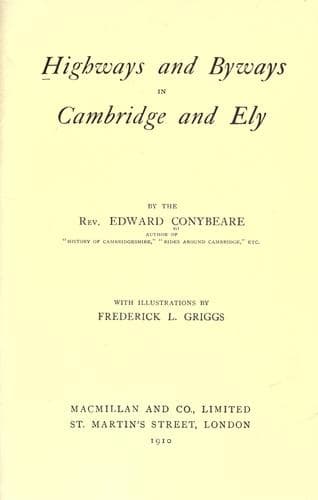
Highways and Byways in Cambridge and ElyConybeare, John William Edward
History
Highways and Byways in Cambridge and Ely
Conybeare, John William Edward
Cambridgeshire (England) -- Description and travel; Isle of Ely (England) -- Description and travel
The other conspicuous building is a round castellated structure that
might well pass for a Norman keep, but is, in fact, the water tower of
Ely, supporting a huge tank into which water is forced from springs at
Isleham some seven miles distant.[231] The inhabitants of the city
have good reason to be thankful for this water supply; not a hundred
years ago the natural springs on the spot were so inadequate for their
use that most of the water for brewing and washing had to be brought
up from the river, slung in a pair of leather bags on horseback, an
arrangement manifestly inconvenient, "though providing," as the
historian adds, "a comfortable subsistence for many industrious poor."
Let us hope that these poor folk did not bear a grudge against Dean
Peacock, to whose zeal the waterworks of Ely are mainly due.
[Footnote 231: See p. 183.]
One of the chief industries of Ely is the making of jam, for which the
rich fruit-growing fields in the neighbourhood supply the material.
And if we follow the main street down to the wharf on the river Ouse
we shall see in the piles of willow wands that lie ready stripped on
its banks, evidence of a much older industry still carried on here.
This is the basket-making, for the which the fenland districts of
Britain were famed even before the Romans reached the country.
Posidonius, the Rhodian geographer under whom Cicero studied, and who
himself visited our island about 100 B.C., mentions "British baskets"
as exported for use on the Continent. A century later Strabo tells us
of their extensive home use, for storing corn, and Martial, in the
next generation, gives us the very word, which was adopted into the
Latin from the Celtic original (still used in Welsh), as it has since
been adopted into English. In sending a present to a lady he alludes
to it as:
"A basket rude, from painted Britons come."
("Barbara de pictis venio _bascauda_ Britannis.")
The withies of which the baskets are made were at first, doubtless,
the shoots of the willows found growing wild along the streams. Now
they are cut from carefully tended osier-beds, small enclosed areas
which are periodically flooded, where the willows are regularly
cultivated with a view to the production of long shoots suitable for
this industry. "They are regularly cut, peeled, and seasoned and
afford employment to large numbers of people."[232] Nor is the making
of baskets the only purpose for which willows may be profitably
cultivated; for, as Fuller says:--"This tree delighteth in moist
places and is triumphant in the Isle of Ely, where the roots
strengthen the banks and the lop affords fuel for the fire. It groweth
incredibly fast; it being a by-word in this county that the profit by
willows will buy the owner a horse before other trees will pay for his
saddle."
[Footnote 232: Hughes. _County Geography of Cambs_, p. 98.]
Public-domain text, read in full here on John Shaqi.
Reviews
Reviews
No reviews yet
Be the first to share your thoughts on this work.
Elsewhere in the archive
Join the Discussion
Join the discussion
Sign in to leave a comment or review.
Sign InorCreate an account